


Thermal imaging cameras on Amazon.de cost from 229.00 euros for the HIKMICRO Mini2 V3, a 256 x 192 pixel phone add-on, to 618.79 euros for the FLIR C5 with a 5 MP camera and MSX overlay. This guide is for homeowners, electricians and installers who want to see where heat escapes, where there's damp in a wall and which fuse is overheating, but don't know what resolution they need or whether a phone add-on is enough. The best thermal imaging cameras of 2027 are the FLIR C5 as the best handheld camera (618.79 euros), the UNI-T UTi260B as the best value for resolution (300.90 euros) and the HIKMICRO Mini2 V3 as the best phone add-on (229.00 euros). We compared seven models with live prices on 31 October 2026.
When comparing, look at the native sensor resolution, not the upscaled image. HIKMICRO and TOPDON advertise 512 x 384, but the sensor has 256 x 192 pixels.
Quick overview: the best thermal imaging cameras 2027
All the thermal imaging cameras in this comparison are available on Amazon.de. Click a name to see the current price.
| Model | Type | Resolution | NETD | Range | Price | Best for |
|---|---|---|---|---|---|---|
| FLIR C5 | handheld | 160 x 120 | below 70 mK | -20 to 400 °C | 618.79 € | Electricians, reports |
| UNI-T UTi260B | handheld | 256 x 192 | below 60 mK | -20 to 550 °C | 300.90 € | Value for resolution |
| HIKMICRO Mini2 V3 | phone add-on | 256 x 192 | below 30 mK | -20 to 650 °C | 229.00 € | Home inspection |
| TOPDON TC002C Duo | phone add-on, USB-C | 256 x 192 | below 40 mK | -20 to 550 °C | 259.99 € | Phone and PC |
| FLIR ONE Edge Pro | wireless add-on | 160 x 120 | 70 mK | -20 to 120 / 0 to 400 °C | 428.39 € | Any phone |
| FLIR TG268 | handheld with laser | 160 x 120 | below 50 mK | -25 to 400 °C | 451.01 € | Heating and HVAC |
| HIKMICRO Lynx LC06S | thermal monocular | 160 x 120 | below 35 mK | doesn't measure | 292.05 € | Wildlife watching |
The data comes from maker pages and datasheets (FLIR, UNI-T, HIKMICRO, TOPDON). Where a figure isn't published, we say so.
How to choose thermal imaging cameras
Resolution
For home use, 160 x 120 pixels is the minimum that shows draughts, cold corners and warm fuses. A 256 x 192 sensor has 49,152 points, about 2.5 times more, so details are clearer. Makers often quote an upscaled image (SuperIR, TISR, super resolution), but compare native resolution (HIKMICRO).
NETD
NETD is the smallest temperature difference a camera can distinguish, in millikelvin (mK). The lower the number, the more shades in the image. FLIR says that at the same resolution, a camera with lower NETD gives a much clearer image (FLIR). The home thermal imaging cameras in this comparison range from 30 to 70 mK.
Phone add-on or handheld
Phone add-ons give 256 x 192 pixels and 25 Hz for 230 to 260 euros, but drain the phone battery and are less protected (the HIKMICRO Mini2 V3 is IP40). Handheld cameras have their own battery, IP54 or IP65 and survive a 2 m drop. If you use the camera on site every week, get a handheld; for an occasional home check, an add-on is enough.
What you can see in a house
FLIR says thermal imaging cameras reveal missing or shifted insulation, draughts around windows and doors and damp in walls, which should be confirmed with a moisture meter (FLIR). Overheating fuses and connections and underfloor heating pipes under concrete also show up. The camera can't see through a wall; it measures the temperature of its surface, and glass acts like a mirror for infrared (FLIR).
When to shoot
For building inspections, Testo asks for an indoor-outdoor temperature difference of at least 10 to 15 °C for at least 12 hours, shooting in the morning before sunrise and wind below 5 m/s (Testo). FLIR says poor insulation can show up at a difference of about 6 °C. That's why winter is the best time for a home inspection.
Emissivity
Emissivity describes how well a surface radiates heat, from 0 (mirror) to 1 (black body). Polished copper and aluminium are below 0.10 and reflect surrounding heat, so the camera shows the wrong temperature. FLIR advises sticking electrical tape on a shiny surface and measuring the tape, and below an emissivity of 0.5 accurate measurement is unlikely (FLIR).
1. FLIR C5
 Photo: FLIR, Amazon
The FLIR C5 is our pick for electricians, installers and more demanding DIYers. The sensor has 160 x 120 pixels, and the 5 MP visual camera and MSX overlay draw edges, labels and screws into the thermal image, so it reads better than the resolution suggests. The range is -20 to 400 °C and the accuracy ±3 °C or ±3%.
It fits in a pocket: 138 x 84 x 24 mm and 190 g, with a 3.5-inch touchscreen. It has Wi-Fi, internal memory for over 5,000 images and the FLIR Ignite cloud for reports. The battery lasts about 4 hours, and the housing is IP54 and survives a 2 m drop. For the price, 8.7 Hz and NETD below 70 mK are modest.
| Feature | Detail |
|---|---|
| Resolution | 160 x 120 |
| NETD | below 70 mK |
| Range | -20 to 400 °C |
| Accuracy | ±3 °C or ±3% |
| Field of view | 54° x 42° |
| Refresh rate | 8.7 Hz |
| Visual camera | 5 MP, MSX |
| Protection | IP54, 2 m drop |
| Weight | 190 g |
| Price | 618.79 € |
Pros: MSX makes the image very readable, pocket size, Wi-Fi and cloud for reports, FLIR calibration and service.
Cons: only 160 x 120 and 8.7 Hz for the price, weaker NETD than cheaper models, battery about 4 hours.
Our opinion: Of all the thermal imaging cameras here, the C5 gives the best reports and the most readable image for a client. For checking your own house, a camera at about a third of the price will do.
2. UNI-T UTi260B
 Photo: UNI-T, Amazon
The UNI-T UTi260B gives a 256 x 192 pixel sensor and up to 25 Hz for 300.90 euros, the best value for resolution among the handheld cameras in this comparison. NETD is below 60 mK, the range -20 to 550 °C and the accuracy ±2 °C or ±2%. Alongside the thermal image it has a visual camera, Fusion and PiP modes.
The housing is IP65 and survives a 2 m drop, and the 5,000 mAh battery is replaceable and lasts at least 6 hours according to UNI-T. Images are saved to the 16 GB microSD card in the box. The 2.8-inch, 320 x 240 screen is small, and the software is more basic than FLIR's. UNI-T doesn't give the weight.
| Feature | Detail |
|---|---|
| Resolution | 256 x 192 |
| NETD | below 60 mK |
| Range | -20 to 550 °C |
| Accuracy | ±2 °C or ±2% |
| Field of view | 56° x 42° |
| Refresh rate | below 25 Hz |
| Screen | 2.8 in, 320 x 240 |
| Battery | 5,000 mAh, replaceable, 6 h or more |
| Protection | IP65, 2 m drop |
| Price | 300.90 € |
Pros: 256 x 192 and up to 25 Hz for about 300 euros, IP65 and replaceable battery, Fusion and PiP.
Cons: small low-resolution screen, bulky pistol shape, weaker software than FLIR.
Our opinion: For a DIYer who wants a real handheld camera without draining a phone, the UTi260B is the most sensible buy. More than twice the pixels of the FLIR C5 for about half the price.
3. HIKMICRO Mini2 V3
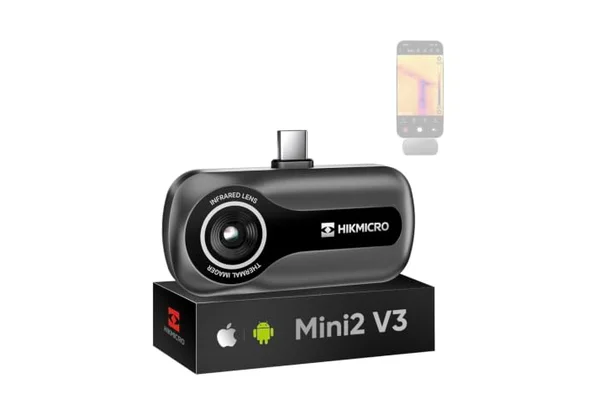 Photo: HIKMICRO, Amazon
The HIKMICRO Mini2 V3 is the best phone add-on in the comparison and the cheapest camera. For 229.00 euros you get a 256 x 192 pixel sensor with NETD below 30 mK, the best in the list, 25 Hz and a range of -20 to 650 °C. Accuracy is ±2 °C or ±2%.
The HIKMICRO Viewer app has ready-made modes for water leaks, insulation, underfloor heating, electrical faults and solar panels, plus alarms for leaks and insulation. The camera weighs 23 g and is powered by the phone, with no battery of its own. There are USB-C and Lightning versions, so buy the right one. Protection is only IP40, and focus is fixed, with a minimum distance of 0.2 m.
| Feature | Detail |
|---|---|
| Resolution | 256 x 192 (512 x 384 display) |
| NETD | below 30 mK |
| Range | -20 to 650 °C |
| Accuracy | ±2 °C or ±2% |
| Refresh rate | 25 Hz |
| Connector | USB-C or Lightning (versions) |
| Power | from the phone |
| Protection | IP40, 1 m drop |
| Weight | 23 g |
| Price | 229.00 € |
Pros: best NETD in the list, 25 Hz, range up to 650 °C, ready-made home inspection modes, tiny.
Cons: drains the phone battery, only IP40, you need to pick the right connector version.
Our opinion: For a home check every winter, the Mini2 V3 is all you need. Before buying, check whether your phone has USB-C or Lightning.
4. TOPDON TC002C Duo
 Photo: TOPDON, Amazon
The TOPDON TC002C Duo is an alternative to the HIKMICRO that also works on a computer. The sensor has 256 x 192 pixels, NETD below 40 mK, 25 Hz and a range of -20 to 550 °C, with ±2 °C or ±2% accuracy. For 259.99 euros it plugs into USB-C phones running iOS and Android, and on a PC it works with the TopView program.
The TopInfrared app has 10 palettes, multi-point tracking, guided home inspection scenarios and report export. This version is USB-C only, so an older iPhone with Lightning needs a different model. TOPDON doesn't publish the weight or IP rating.
| Feature | Detail |
|---|---|
| Resolution | 256 x 192 (512 x 384 display) |
| NETD | below 40 mK |
| Range | -20 to 550 °C |
| Accuracy | ±2 °C or ±2% |
| Refresh rate | 25 Hz |
| Connector | USB-C, iOS and Android |
| PC | TopView |
| Weight and IP | not published |
| Price | 259.99 € |
Pros: 256 x 192 and 25 Hz for about 260 euros, works on a PC too, guided scenarios for beginners.
Cons: USB-C only, weight and protection not published, drains the phone battery.
Our opinion: The TC002C Duo beats the HIKMICRO if you want to view your images on a computer. Its NETD is slightly weaker.
5. FLIR ONE Edge Pro
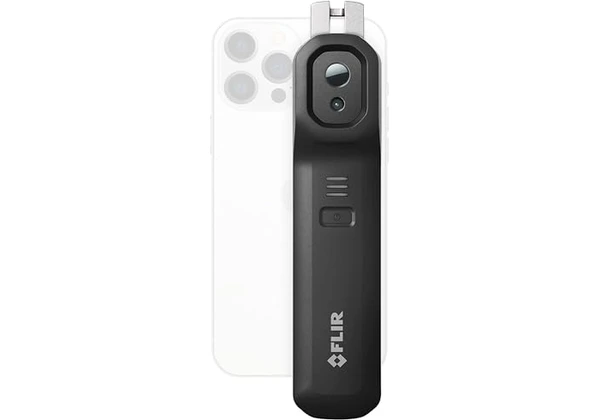 Photo: FLIR, Amazon
The FLIR ONE Edge Pro is a wireless add-on that clips onto a phone and connects over Bluetooth and Wi-Fi, so it doesn't depend on the connector. It works up to 5 m from the phone, with iOS 17 or later and Android 13 or later. The sensor has 160 x 120 pixels, and with the visual camera and MSX it gives a readable image.
NETD is 70 mK, the ranges -20 to 120 °C and 0 to 400 °C and the accuracy ±3 °C or ±5%. Its own battery lasts about 2.5 hours, the housing is IP54 and survives a 2 m drop, and it weighs 153 g. At 428.39 euros and 8.7 Hz, this is an expensive 160 x 120 sensor.
| Feature | Detail |
|---|---|
| Resolution | 160 x 120 |
| NETD | 70 mK |
| Range | -20 to 120 / 0 to 400 °C |
| Accuracy | ±3 °C or ±5% |
| Refresh rate | 8.7 Hz |
| Connection | Bluetooth + Wi-Fi, up to 5 m |
| Battery | about 2.5 h |
| Protection | IP54, 2 m drop |
| Weight | 153 g |
| Price | 428.39 € |
Pros: wireless, works with almost any recent phone, MSX, IP54 and 2 m drop.
Cons: expensive for 160 x 120, 8.7 Hz and NETD 70 mK, battery about 2.5 hours.
Our opinion: The Edge Pro makes sense if you change phones often or have both iPhone and Android at home. Otherwise the HIKMICRO Mini2 V3 gives a better sensor for about 200 euros less.
6. FLIR TG268
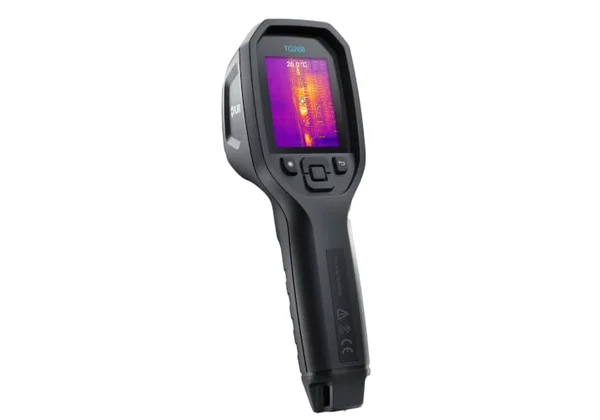 Photo: FLIR, Amazon
The FLIR TG268 is a handheld camera with a class 1 laser pointer that marks exactly where it measures. The sensor has 160 x 120 pixels with MSX, NETD below 50 mK, better than the FLIR C5, and a range of -25 to 400 °C. Accuracy is ±2.5 °C or ±2.5% over most of the range.
The battery lasts 5 hours of scanning, the housing is IP54 and survives a 2 m drop, and 8 GB of internal memory stores images with spot temperature. The 2.4-inch screen is small, Wi-Fi isn't in the specs, and it weighs 394 g. At 451.01 euros it's cheaper than the C5.
| Feature | Detail |
|---|---|
| Resolution | 160 x 120 |
| NETD | below 50 mK |
| Range | -25 to 400 °C |
| Accuracy | ±2.5 °C or ±2.5% |
| Refresh rate | 8.7 Hz |
| Laser | class 1 |
| Battery | 5 h |
| Protection | IP54, 2 m drop |
| Weight | 394 g |
| Price | 451.01 € |
Pros: laser shows the measuring spot, better NETD than the C5, rugged for heating, HVAC and electrical work.
Cons: native 160 x 120 only, 8.7 Hz, small screen, Wi-Fi not listed.
Our opinion: The TG268 is for heating and HVAC technicians who measure pipes and connections. For checking a whole facade, a 256 x 192 sensor is better.
7. HIKMICRO Lynx LC06S
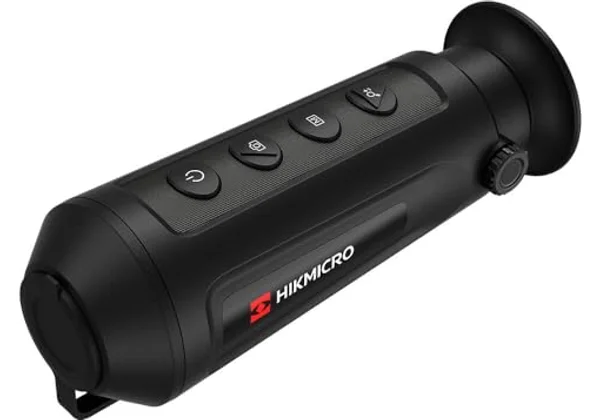 Photo: HIKMICRO, Amazon
The HIKMICRO Lynx LC06S is a thermal monocular for wildlife watching and night walks, not for home inspection: it doesn't measure temperature. The 160 x 120 VOx sensor runs at 50 Hz with NETD below 35 mK, so moving animals look smooth. HIKMICRO gives a detection range of 250 m.
The OLED eyepiece has 800 x 600 pixels, and zoom is digital from 1x to 4x. The battery lasts up to 10 hours, the housing is IP67, and it weighs 250 g. It records photos and video to 8 GB of memory and connects to a phone over Wi-Fi. With 160 x 120 pixels, it isn't made for identification at long range.
| Feature | Detail |
|---|---|
| Resolution | 160 x 120, VOx |
| NETD | below 35 mK |
| Refresh rate | 50 Hz |
| Field of view | 24.7° x 18.7° |
| Detection range | 250 m |
| Eyepiece | OLED 800 x 600 |
| Battery | up to 10 h |
| Protection | IP67 |
| Weight | 250 g |
| Price | 292.05 € |
Pros: 50 Hz for a smooth image, IP67 and up to 10 hours of battery, light, records video.
Cons: only 160 x 120, doesn't measure temperature, use in hunting grounds is subject to hunting law.
Our opinion: The Lynx is for watching wildlife, finding a pet in the dark and night walks. Before taking it into a hunting ground, read the section on the law below.
Thermal imaging and hunting in Croatia
The Croatian Hunting Act (NN 99/18 and amendments), Art. 66(1)(8), bans hunting "with optical sights for night hunting with electronic magnification or image conversion". Under Art. 66(2), carrying such means in a hunting ground outside a residential building counts as hunting, unless a special permit has been issued. The Ministry can grant an exception, and for wild boar, fox and jackal outside protected nature areas the nature-protection ministry's consent isn't required (Art. 66(4) and (6)). The law explicitly mentions sights; it doesn't mention a monocular used only for observation, so check with the Ministry of Agriculture or the hunting association before taking one into a hunting ground. Outside Croatia, check your local rules.
Conclusion: which thermal imaging cameras to choose?
For electricians and installers the best choice is the FLIR C5 for 618.79 euros, thanks to MSX and reports. For DIYers the UNI-T UTi260B gives 256 x 192 pixels in a handheld for 300.90 euros. For an occasional home check, the HIKMICRO Mini2 V3 for 229.00 euros is enough. Use thermal imaging cameras on a house in winter, in the morning, with a large indoor-outdoor temperature difference.
| If you care about | Choose | Price |
|---|---|---|
| Reports and a readable image | FLIR C5 | 618.79 € |
| Handheld, 256 x 192 | UNI-T UTi260B | 300.90 € |
| Cheapest home check | HIKMICRO Mini2 V3 | 229.00 € |
| Phone and computer | TOPDON TC002C Duo | 259.99 € |
| Any phone, wireless | FLIR ONE Edge Pro | 428.39 € |
| Laser for heating and HVAC | FLIR TG268 | 451.01 € |
| Wildlife watching | HIKMICRO Lynx LC06S | 292.05 € |
To check electrical installations you also need a digital multimeter. If the camera shows damp, a dehumidifier will help, and to save on heating there's a smart thermostat. For daytime observation there are binoculars.
Frequently asked questions
What resolution is enough for a home inspection?
160 x 120 pixels is the minimum that shows draughts, cold corners and warm fuses. A 256 x 192 sensor has about 2.5 times more points and clearer details. Look at native resolution, not the upscaled 512 x 384 image.
What does NETD mean?
NETD is the smallest temperature difference a camera can distinguish, in millikelvin. The lower the number, the more shades in the image. Home cameras have 30 to 70 mK, and below 50 mK is good for finding damp and thermal bridges.
What can thermal imaging cameras find in a house?
Missing insulation, draughts around windows and doors, damp and leaks (confirmed with a moisture meter), underfloor heating pipes and overheating fuses. The camera can't see through a wall, only the temperature of its surface.
Phone add-on or handheld?
An add-on gives 256 x 192 pixels for 230 to 260 euros, but drains the phone battery and is less protected. A handheld has its own battery, IP54 or IP65 and survives a 2 m drop, so it's better for frequent work.
Can thermal imaging be used for hunting?
In Croatia, the Hunting Act (Art. 66(1)(8)) bans hunting with optical sights for night hunting with electronic magnification or image conversion, unless the Ministry grants a permit. A monocular used only for observation isn't mentioned, so check with the Ministry or the hunting association.
How accurate are they?
HIKMICRO, UNI-T and TOPDON quote ±2 °C or ±2%, and the FLIR models ±2.5 to ±3 °C (Edge Pro up to ±5%). That's enough to compare warm and cold spots, but not to measure like a calibrated contact thermometer. On shiny metal, measure a piece of electrical tape.
How we chose
We chose these thermal imaging cameras by native resolution, NETD, range and accuracy, refresh rate, housing protection, software and price. We reviewed 10 models available on Amazon.de and checked each ASIN through Amazon's API. Technical data comes from FLIR, UNI-T, HIKMICRO and TOPDON pages and datasheets. We left out models without a maker page, with conflicting data, with upscaled resolution presented as native and models over 700 euros. Prices are live Amazon.de prices on 31 October 2026. We did not physically test the products.
Sources and references
- FLIR - Energy efficiency for homes with thermal imaging
- FLIR - Can thermal imaging see through walls
- FLIR - Emissivity
- FLIR - Thermal sensitivity (NETD)
- Testo - Practical guide to building thermography
- Croatian Hunting Act, consolidated text
- FLIR C5
- FLIR TG268
- FLIR ONE Edge Pro
- UNI-T UTi260B manual
- HIKMICRO Mini2 V3
- TOPDON TC002C Duo
- HIKMICRO Lynx LC06S datasheet
Related articles: