


Duvets in 135x200 cm on Amazon.de cost from 29.99 euros for the synthetic Badenia Trendline to 249.00 euros for the Paradies Gabi 90 with 90% goose down. This guide is for anyone looking for a new duvet before winter who isn't sure whether down or synthetic is better, which duvet suits allergy sufferers, and how to wash it so it lasts. The best duvets of 2027 are the Paradies Gabi 90 as the best down duvet (249.00 euros), the Traumnacht Royal as the most affordable real down duvet (65.90 euros) and the Badenia Trendline 4-season as the cheapest duvet for allergy sufferers that can be boil-washed at 95 °C (29.99 euros). We compared seven models with live prices on 2 November 2026.
Good news from Stiftung Warentest's October 2026 test: the cheapest synthetic duvet tested, at 24 euros, slept better than a 179-euro model.
Quick overview: the best duvets of 2027
All the duvets in this comparison are 135x200 cm and available on Amazon.de. Click a name to see the current price.
| Model | Filling | Warmth | Washing | Certification | Price | Best for |
|---|---|---|---|---|---|---|
| Paradies Gabi 90 | 90% goose down, 665 g | medium | 40 °C | RDS | 249.00 € | Best down |
| Billerbeck E04 Gold Edition | 90% down | medium | 60 °C | traceable origin | 135.90 € | Down and mites |
| Traumnacht Royal | 70% down, 550 g | medium | 60 °C | OEKO-TEX | 65.90 € | Down on a budget |
| Paradies Prima Varietta | synthetic, 2 parts | 4 seasons | 60 °C | organic cotton | 149.00 € | All year |
| Badenia Trendline 4-season | hollow fibre, 700 g + 400 g | 4 seasons | 95 °C | OEKO-TEX | 29.99 € | Allergies, small budget |
| Traumnacht Kamelhaar Mono | camel hair, 1,000 g | medium | air only | OEKO-TEX | 76.90 € | Night sweats |
| franknatur Lyocell | Tencel, 1,000 g | light | 60 °C | OEKO-TEX | 123.50 € | Wood-based cellulose fibre |
The data comes from manufacturer descriptions on Amazon.de and manufacturer pages. Each manufacturer sets its own warmth ratings, so only compare them within the same brand.
How to choose duvets
Down or synthetic
Down gives the most warmth for its weight: the higher the share of down compared to feathers, the warmer and lighter the duvet (Wikipedia). Hollow polyester fibre duvets are almost as light, cheaper and easy to wash. Wool and camel hair regulate moisture well but are heavier. The DIN EN 12934 standard sets how the composition of down and feather filling must be labelled (DIN), so a ratio like 90/10 means 90% down and 10% feathers.
Warmth and warmth ratings
Stiftung Warentest measures thermal resistance itself because warmth classes aren't defined uniformly (Stiftung Warentest). Paradies's "3 out of 5 hearts" and Billerbeck's "medium" aren't comparable. Look at fill weight and down share, and for a cold bedroom get a winter model or a 4-season duvet. Boxes with 1 to 2 cm side walls stop the filling from shifting and leaving cold spots.
Duvets for allergy sufferers
Feather duvets are often better for allergy sufferers than their reputation: with a house dust allergy, the problem is dust mite droppings, not feathers. The German allergy association DAAB advises washing duvets at at least 60 °C roughly every three months, or every 4 to 6 weeks for stronger allergies (ZDF). Feathers aren't off limits: in a randomised trial of 197 mite-sensitised children with asthma, all with mite-proof mattress covers, feather bedding didn't worsen symptoms (Archives of Disease in Childhood), and a Tasmanian study linked feather duvets to less mite sensitisation (ANU). What matters for allergy sufferers is that the duvet can be washed at 60 °C or higher.
RDS, Downpass and bird welfare
RDS (Responsible Down Standard) bans plucking feathers from live birds and force-feeding, with independent audits and tracking from farm to finished duvet (Textile Exchange). Downpass likewise excludes live plucking and feathers from foie gras production, and every product has a tracking number (Downpass). In its 2020 down duvet test, Stiftung Warentest also checked animal welfare: every supplier had a certificate, but only three of ten could fully prove where the down came from. So a certificate is a minimum standard, not a guarantee.
Size, washing and lifespan
In Germany the standard single size is 135x200 cm, comfort 155x220 cm, and for a double bed 200x200 or 200x220 cm. Leave out fabric softener when washing a down duvet, and dry it in the tumble dryer on medium heat with 2 or 3 tennis balls (t-online). Don't wash wool or camel hair; just air them. As a rough guide, down duvets last 5 to 10 years, and up to 15 with good care, while synthetic ones last 6 to 8 years (t-online).
1. Paradies Gabi 90
 Photo: Paradies, Amazon
The Paradies Gabi 90 is an all-season duvet with 90% white goose down and 10% feathers, with 665 g of filling at a total weight of 1,550 g. It's stitched in 5 x 7 boxes with 1.5 cm side walls, so the filling doesn't shift and there are no cold spots. Paradies rates it as medium warmth, three out of five "warmth hearts".
The down is RDS certified, the cover is cotton, and the duvet is made in Germany. It washes at 40 °C and can go in the dryer. For dust mite allergy sufferers that's the weak point, because 40 °C doesn't kill mites like 60 °C does. For a very cold bedroom, Paradies also sells the Gabi 90 as a winter duvet with 875 g of filling.
| Feature | Detail |
|---|---|
| Filling | 90% goose down, 10% feathers, 665 g |
| Stitching | 5 x 7 boxes, 1.5 cm walls |
| Warmth | medium (Paradies) |
| Cover | 100% cotton |
| Washing | 40 °C, tumble dryer |
| Certification | RDS |
| Price | 249.00 € |
Pros: high goose down share at a low weight, boxes without cold spots, RDS certification, made in Germany.
Cons: most expensive in this comparison, washes only at 40 °C, a very cold room needs a warmer model.
Our opinion: Of all the duvets in this comparison, the Gabi 90 is the best down duvet with verifiable origins. It's light, warm, and with RDS you know where the down comes from.
2. Billerbeck E04 Gold Edition
 Photo: Billerbeck, Amazon
The Billerbeck E04 Gold Edition is a down duvet that washes at 60 °C, which not all down duvets can. The filling is 90% down and 10% feathers in boxes, and the cover is fine cotton. Billerbeck lists it as suitable for house dust allergy sufferers, precisely because of the 60 °C wash.
According to the manufacturer, the origin of the filling can be traced back to the egg. The model comes in four warmth levels; this is the medium one, for all year. The fill weight isn't published for this size.
| Feature | Detail |
|---|---|
| Filling | 90% down, 10% feathers |
| Stitching | boxes |
| Warmth | medium (of 4 levels) |
| Cover | fine cotton |
| Washing | 60 °C |
| Origin | traceable (Billerbeck) |
| Price | 135.90 € |
Pros: down that washes at 60 °C, traceable origin, German maker since 1921, four warmth levels.
Cons: fill weight not stated, check the certification mark on the label.
Our opinion: The E04 Gold Edition is the best choice for people who want down but have a dust mite allergy. Washing at 60 °C solves the biggest problem with feather duvets.
3. Traumnacht Royal
 Photo: Traumnacht, Amazon
The Traumnacht Royal is the most affordable real down duvet in this comparison, at 65.90 euros. It has 70% down and 30% feathers, 550 g of filling at a total weight of 1,370 g, and internal walls that keep the filling in place. The cover is densely woven cotton with a soft finish.
It washes at 60 °C and can go in the dryer, and it's OEKO-TEX certified. According to Traumnacht the down isn't obtained by live plucking, but it has no RDS or Downpass certificate, so that's only the manufacturer's word. With 550 g of filling it's averagely warm, not for cold rooms.
| Feature | Detail |
|---|---|
| Filling | 70% down, 30% feathers, 550 g |
| Stitching | internal walls |
| Warmth | medium |
| Cover | 100% cotton |
| Washing | 60 °C, tumble dryer |
| Certification | OEKO-TEX (no RDS) |
| Price | 65.90 € |
Pros: down for little money, washes at 60 °C and dryer-safe, soft cotton cover.
Cons: no RDS or Downpass, average warmth, new model with little track record.
Our opinion: The Traumnacht Royal is the right pick if you want the feel of down on a budget under 70 euros. If bird welfare matters to you, get the Paradies.
4. Paradies Prima Varietta
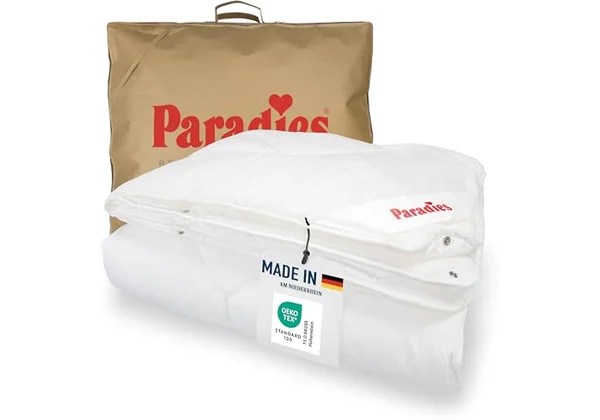 Photo: Paradies, Amazon
The Paradies Prima Varietta is a 4-season duvet: a light summer duvet and a transitional one that press-stud together into a winter duvet. The filling is Paradies Fill synthetic fibre, and the cover is organically grown cotton. You store the part you're not using in the included bag.
It washes at up to 60 °C, though Paradies recommends 40 °C, and can go in the dryer; wash the parts separately. It's made in Germany. At 149.00 euros it costs more than most synthetic 4-season duvets, and you may feel the press studs.
| Feature | Detail |
|---|---|
| Construction | 2 parts, joined with press studs |
| Filling | Paradies Fill synthetic |
| Cover | organic cotton |
| Washing | up to 60 °C, tumble dryer |
| Extra | storage bag |
| Price | 149.00 € |
Pros: one duvet for the whole year, no animal materials, washes at 60 °C, organic cotton.
Cons: pricier than other synthetic models, press studs can be felt, synthetic is heavier than down.
Our opinion: The Prima Varietta is for people who want one duvet for the whole year without feathers. The Badenia offers the same for less, but with a microfibre cover.
5. Badenia Trendline 4-season
 Photo: Badenia, Amazon
The Badenia Trendline 4-season is the cheapest duvet in this comparison, at 29.99 euros, and the most hygienic: it can be boil-washed at 95 °C. It has two parts, with 700 g and 400 g of four-channel hollow polyester fibre, that join together for winter. The cover is microfibre, the duvet is OEKO-TEX certified, and according to the product title it's made in Germany.
Badenia recommends it for house dust allergy sufferers. The microfibre cover breathes less well than cotton, so it doesn't suit people who sweat a lot at night. With 1,100 g of filling in total, it's heavier than down.
| Feature | Detail |
|---|---|
| Construction | 2 parts, 700 g + 400 g |
| Filling | hollow polyester fibre |
| Cover | microfibre |
| Washing | up to 95 °C, tumble dryer |
| Certification | OEKO-TEX Standard 100 |
| Price | 29.99 € |
Pros: boil-washable at 95 °C, lowest price, two parts for summer and winter, OEKO-TEX.
Cons: microfibre breathes less well, heavier than down, no stitching details.
Our opinion: For allergy sufferers and guest rooms, the Badenia is the best buy. For 30 euros you get two parts that can be boil-washed, and a guest room doesn't need more.
6. Traumnacht Kamelhaar Mono
 Photo: Traumnacht, Amazon
The Traumnacht Kamelhaar Mono is a duvet with 1,000 g of camel hair in a cotton batiste cover. Camel hair wicks moisture well, so it stays dry underneath even for people who sweat at night. For a natural filling it's affordable, at 76.90 euros, and it's OEKO-TEX certified.
Traumnacht recommends airing it regularly instead of washing it, because camel hair mats easily. So it's not for dust mite allergy sufferers, who need 60 °C washing. It's heavier than down.
| Feature | Detail |
|---|---|
| Filling | 100% camel hair, 1,000 g |
| Warmth | medium, all-season |
| Cover | cotton batiste |
| Care | air only (maker's advice) |
| Certification | OEKO-TEX Standard 100 |
| Price | 76.90 € |
Pros: wicks moisture very well, natural fibre, affordable for a natural filling.
Cons: maker recommends airing only, not for dust mite allergy sufferers, heavier than down.
Our opinion: The Kamelhaar Mono is for people who wake up sweaty under synthetic duvets. If you have a dust mite allergy, skip it.
7. franknatur Lyocell
 Photo: franknatur, Amazon
The franknatur Lyocell is an all-season duvet with 1,000 g of Tencel filling, a wood-based cellulose fibre that absorbs and releases moisture quickly. The cover is unbleached organic cotton, and the duvet is made in Germany with OEKO-TEX certification. It suits vegans and allergy sufferers.
It washes at 60 °C and can go in the dryer. At 123.50 euros it costs more than synthetic, and it's too thin for winter in a cold room. Like other duvets with plant or synthetic filling, it's heavier than down.
| Feature | Detail |
|---|---|
| Filling | 100% Lyocell (Tencel), 1,000 g |
| Warmth | light, all-season |
| Cover | unbleached organic cotton |
| Washing | 60 °C, tumble dryer |
| Certification | OEKO-TEX Standard 100 |
| Price | 123.50 € |
Pros: cellulose fibre that handles moisture well, vegan, washes at 60 °C, organic cotton.
Cons: pricier than synthetic, too thin for cold rooms, heavier than down.
Our opinion: The Lyocell is for people who want a natural but not animal filling. For winter in a cold room, get a down or 4-season duvet.
Conclusion: which duvets to choose?
For most people the best choice is the Paradies Gabi 90 at 249.00 euros, and on a smaller budget the Traumnacht Royal with down at 65.90 euros. Allergy sufferers will do best with the boil-washable Badenia or the Billerbeck that washes at 60 °C. All duvets in this comparison come in 135x200 cm, and for a double bed check the 200x200 or 200x220 cm variant.
| If you care most about | Choose | Price |
|---|---|---|
| Best down, RDS | Paradies Gabi 90 | 249.00 € |
| Down and dust mite allergy | Billerbeck E04 Gold Edition | 135.90 € |
| Down on a budget | Traumnacht Royal | 65.90 € |
| All year without feathers | Paradies Prima Varietta | 149.00 € |
| Allergies, small budget | Badenia Trendline 4-season | 29.99 € |
| Night sweats | Traumnacht Kamelhaar Mono | 76.90 € |
| Wood-based cellulose fibre | franknatur Lyocell | 123.50 € |
With a new duvet, also look at mattresses and ergonomic pillows. For cold evenings there are heating pads, and for better sleep sleep gadgets.
Frequently asked questions
Down or synthetic?
Down gives the most warmth for the least weight and lasts a long time, but costs more. Synthetic is cheaper, washes easily at high temperatures and is good for allergy sufferers. For a cold bedroom and people who like a light duvet, down is better.
Which duvet for winter?
For a cold room, choose a winter down duvet with a high down share or a 4-season duvet whose parts join together. Warmth ratings aren't uniform, so compare fill weight and down share. Boxes with side walls prevent cold spots.
Which duvet for allergy sufferers?
One that washes at 60 °C or more, because high temperatures kill dust mites. DAAB advises washing every three months. Feathers themselves usually aren't the problem; the Billerbeck E04 and the synthetic Badenia wash at 60 °C and 95 °C respectively.
How do I wash a down duvet?
In the machine with a mild detergent at the temperature on the label, without fabric softener. Dry it in the tumble dryer on medium heat with 2 or 3 tennis balls and shake it out now and then. Don't wash wool or camel hair; just air them.
What do RDS and Downpass mean?
Both standards exclude live plucking and force-feeding (foie gras production) and require independent checks and proof of origin. A manufacturer's statement without certification is less reliable.
How often should you replace a duvet?
Down duvets last 5 to 10 years, and up to 15 with good care. Synthetic ones last 6 to 8 years. It's time to replace a duvet when the filling clumps or it no longer keeps you as warm as before.
How we chose
We chose duvets based on filling type and amount, stitching, cover, washing temperature, certifications and price, all in 135x200 cm. We looked at 10 models available on Amazon.de and checked every ASIN through the Amazon API. The data comes from manufacturer descriptions on Amazon.de, and the advice on warmth, allergies and care from Stiftung Warentest, the German allergy association DAAB, studies and the RDS and Downpass certification bodies. Individual model grades from the Stiftung Warentest test aren't publicly available, so we don't give them. Prices are live Amazon.de prices on 2 November 2026. We didn't physically test the duvets.
Sources and references
- Stiftung Warentest - Duvets and mattresses tested 2026
- Stiftung Warentest - Duvets tested
- Stiftung Warentest - Down duvets 2020
- DIN EN 12934 - Labelling of feather filling
- Textile Exchange - Responsible Down Standard
- Downpass
- ZDF - Dust mites in bed (DAAB)
- Techniker Krankenkasse - Dust mite allergy
- Archives of Disease in Childhood - Feather bedding and asthma
- ANU - Feather bedding and dust mite sensitisation
- t-online - Washing a down duvet
- t-online - Buying and cleaning duvets
- Wikipedia - Bettdecke
Related articles: