
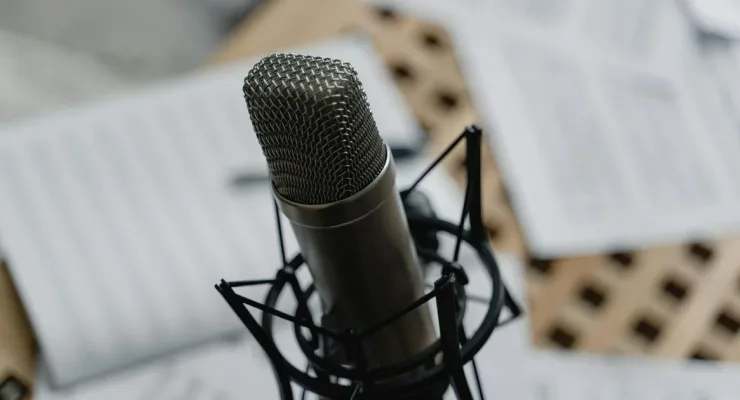

Looking for the right microphone for podcasting or streaming in 2026, the range is wide - a USB condenser for 30 euros on one end, a professional dynamic with dual USB-C and XLR output for 298 euros on the other. We compared 7 microphones for podcasting and streaming from absolute beginner models to the ones professional podcasters actually buy. This review is organized from most to least expensive, because expensive isn't always better - it depends on what you need.
Quick Overview: Microphones for Podcasting
| Model | Price | Connector | Type |
|---|---|---|---|
| Shure MV7+ | 298 EUR | USB-C + XLR | Dynamic |
| Audio-Technica AT2020USB-X | 129 EUR | USB-C | Condenser |
| Blue Yeti X | 140 EUR | Micro-USB | Condenser |
| Elgato Wave:3 | 130 EUR | USB-C | Condenser |
| HyperX QuadCast S | 119 EUR | USB-C | Condenser |
| RODE NT-USB Mini | 85 EUR | USB-C | Condenser |
| FIFINE K669B | 30 EUR | USB-A | Condenser |
1. Shure MV7+
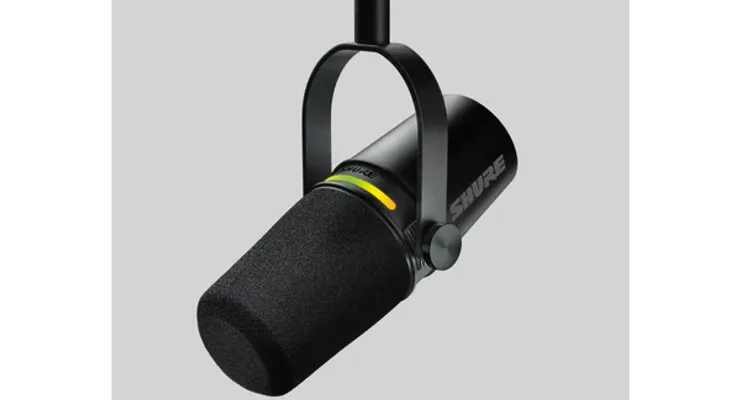 Photo: Shure, shure.com
The Shure MV7+ is the only microphone in this comparison that works simultaneously as both a USB and XLR mic - connect it directly to your computer today, then switch to XLR when you buy an audio interface, without replacing the microphone. It's unique precisely because it offers USB-C and XLR output at the same time. Auto Level Mode automatically adjusts speech volume, the MOTIV Mix app brings a real-time denoiser, a three-band EQ, and reverb effects, and the dynamic capsule naturally rejects room background noise. According to the SoundGuys review, the MV7+ is OBS-certified and compatible with iPhone 15+ via USB-C, making it one of the most versatile options on the market.
| Specification | Shure MV7+ |
|---|---|
| Microphone type | Dynamic |
| Connector | USB-C + XLR (simultaneous) |
| Polar pattern | Cardioid |
| Frequency response | 50 Hz - 16,000 Hz |
| Sample rate | 24-bit / 48 kHz |
| Auto Level Mode | Yes |
| MOTIV Mix app | Yes (denoiser, EQ, reverb) |
| OBS-certified | Yes |
| Price | 298.00 EUR |
Pros: dual USB-C + XLR grows with the user from beginner to professional, excellent voice isolation from the dynamic capsule, MOTIV Mix with real-time denoiser and EQ
Cons: most expensive in the comparison (~298 EUR), LED touch panel can accidentally activate mute
Our opinion: The Shure MV7+ is the only microphone here you won't need to replace when you move to a more serious setup - XLR stays as an option when you get an audio interface. At 298 EUR that's an investment, but it's the microphone professionals actually buy. If you know you'll podcast long-term and don't want to buy twice, this is the right pick.
2. Audio-Technica AT2020USB-X
 Photo: Audio-Technica, soundguys.com
The Audio-Technica AT2020USB-X holds the audio resolution record in this podcast microphone comparison - 24-bit at 96 kHz, a higher sample rate than every other model in this review. It's based on the AT2020 capsule that Audio-Technica has been making since 2004 for studio use, now in USB-C format without needing an audio interface. A touch-mute sensor with LED indicator and Mix control for blending the microphone with computer playback are included at no extra cost. According to the TechRadar test, the AT2020USB-X delivers cleaner and more accurate sound than most USB competitors in a similar price range.
| Specification | AT2020USB-X |
|---|---|
| Microphone type | Condenser |
| Connector | USB-C |
| Polar pattern | Cardioid |
| Frequency response | 20 Hz - 20,000 Hz |
| Sample rate | 24-bit / 96 kHz (highest in comparison) |
| Touch mute | Yes (sensor + LED) |
| Mix control | Yes |
| Monitoring | 3.5 mm jack |
| Price | 129.00 EUR |
Pros: 24-bit/96 kHz sample rate - audiophile-level detail, clean and accurate sound that outperforms similarly priced competitors, solid build with touch-mute sensor
Cons: no hardware gain dial (volume control is software only), single cardioid pattern only
Our opinion: The AT2020USB-X is for anyone who wants recordings to sound as faithful to their voice as possible without post-production work. 96 kHz is more than enough for podcast and streaming - more than you actually need, but it never hurts. For 129 EUR, there's no serious USB competition at this level of vocal detail.
3. Blue Yeti X
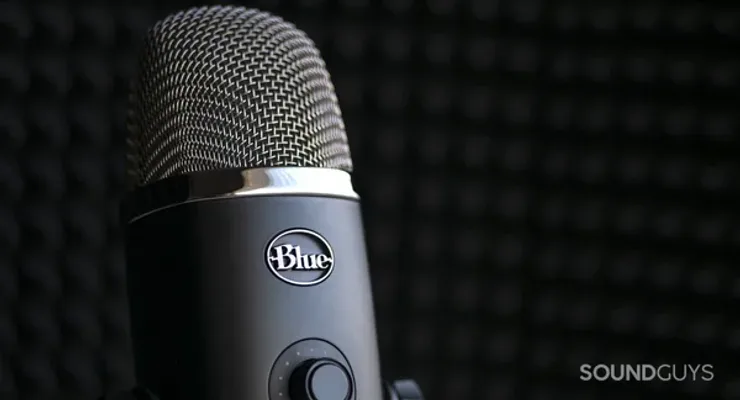 Photo: Logitech/Blue, soundguys.com
The Blue Yeti X is the most versatile condenser microphone for podcasting in this comparison - four polar patterns (cardioid, omnidirectional, bidirectional, and stereo) cover every situation: solo podcast, guest interview seated across from you, conference call, and ASMR recording. An 11-segment LED VU meter shows signal level in real time directly on the mic, without opening any software. Blue VO!CE effects bring EQ, limiter, de-popper, and noise gate via the Logitech G HUB app. According to the SoundGuys test, audio quality holds up well against newer competitors despite the older Micro-USB connector.
| Specification | Blue Yeti X |
|---|---|
| Microphone type | Condenser (4-capsule array) |
| Connector | Micro-USB |
| Polar pattern | Cardioid, Omni, Bidirectional, Stereo |
| Frequency response | 20 Hz - 20,000 Hz |
| Sample rate | 24-bit / 48 kHz |
| Blue VO!CE effects | Yes (EQ, limiter, de-popper, gate) |
| LED VU meter | Yes (11 segments) |
| Monitoring | 3.5 mm jack |
| Price | 140.00 EUR |
Pros: 4 polar patterns for solo/interview/conference/ASMR, Blue VO!CE voice effects and hardware LED VU meter, solid build with desktop stand
Cons: older Micro-USB connector (not USB-C), large and heavy for smaller desks
Our opinion: The Yeti X makes sense if you plan to record a conversation with a guest sitting across from you - the bidirectional pattern handles that well. For solo podcasting, the AT2020USB-X or Elgato Wave:3 offer better value for less money. At 140 EUR with a Micro-USB connector in 2026, it's a harder sell.
4. Elgato Wave:3
 Photo: Elgato, soundguys.com
The Elgato Wave:3 has one feature no other podcast microphone in this comparison can match: Clipguard technology. A secondary capsule is always on standby - the moment the primary detects a signal about to clip and distort, the secondary takes over without interruption. You'll never have a ruined recording because someone spoke too loudly or laughed too hard. Wave Link software goes a step further with support for up to 9 independent audio sources and two separate mixes. According to the SoundGuys review, the Wave:3 delivers 24-bit/96 kHz at a competitive price of around 130 EUR.
| Specification | Elgato Wave:3 |
|---|---|
| Microphone type | Condenser |
| Connector | USB-C |
| Polar pattern | Cardioid |
| Frequency response | 20 Hz - 20,000 Hz |
| Sample rate | 24-bit / 96 kHz |
| Clipguard | Yes (secondary capsule) |
| Wave Link software | Yes (9 sources, 2 independent mixes) |
| Rotary dial | Yes (gain/volume/crossfade) |
| Price | 130.00 EUR |
Pros: Clipguard anti-distortion is unique in the category - prevents ruined recordings, Wave Link software is the most powerful bundled mixing software among USB microphones, 24-bit/96 kHz
Cons: cardioid pattern only, no flexibility for interviews, slightly weaker bass response compared to AT2020USB-X
Our opinion: Clipguard is one of those features you don't appreciate until it saves a recording once. If you laugh a lot, shout with excitement, or have loud guests, the Wave:3 is the only USB microphone that guarantees clean audio. Wave Link software handles the rest. Solid value at 130 EUR.
5. HyperX QuadCast S
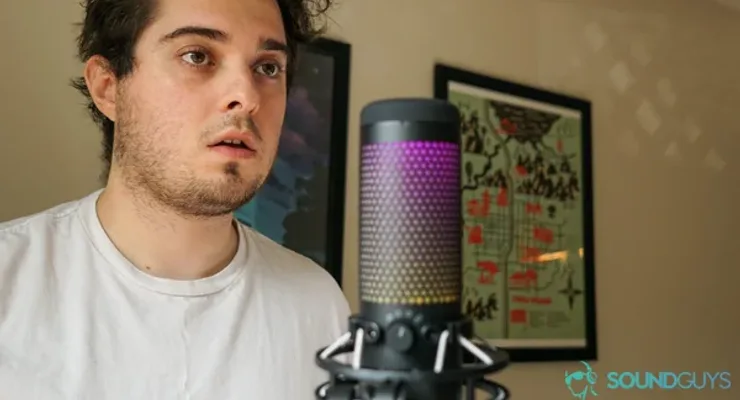 Photo: HyperX, soundguys.com
The HyperX QuadCast S is a recognizable choice among gaming microphones for podcasting and streaming, thanks to RGB lighting that turns off when the mic is muted - visual feedback that's more useful than it sounds. A built-in anti-vibration shock mount absorbs desk vibrations, and an integrated foam pop filter stops plosives without any extra purchases. Four polar patterns and a hardware gain dial give physical control without software. Discord and TeamSpeak certification plus PS4/PS5 compatibility means it works with consoles without drivers. According to the SoundGuys test, audio quality holds up well despite the 16-bit/48 kHz resolution.
| Specification | HyperX QuadCast S |
|---|---|
| Microphone type | Condenser (3x14mm) |
| Connector | USB-C |
| Polar pattern | Cardioid, Omni, Bidirectional, Stereo |
| Frequency response | 20 Hz - 20,000 Hz |
| Sample rate | 16-bit / 48 kHz |
| RGB lighting | Yes (HyperX NGenuity) |
| Shock mount | Yes (built-in) |
| Pop filter | Yes (integrated, foam) |
| Gain dial | Yes (hardware) |
| Discord certified | Yes |
| Price | 119.00 EUR |
Pros: RGB lighting with zone customization via NGenuity software, built-in shock mount and pop filter, 4 polar patterns and hardware gain dial
Cons: 16-bit/48 kHz lower audio resolution than 24-bit competitors, NGenuity RGB software is Windows-only
Our opinion: The QuadCast S is for someone who wants the setup to look good - RGB that reacts to mute status is a smart implementation. For pure audio quality, the AT2020USB-X or Wave:3 deliver 24-bit for a similar or lower price. If you game and stream and PS5 compatibility matters, the QuadCast S makes sense.
6. RODE NT-USB Mini
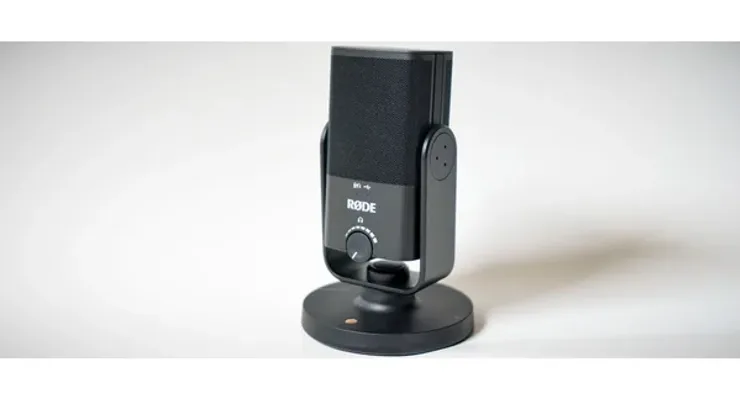 Photo: RODE, tomsguide.com
The RODE NT-USB Mini is the most practical compact microphone for podcasting beginners who want studio sound without buying extra accessories. The built-in magnetic pop filter and desktop stand come in the box - unbox, plug in, record. Done in under a minute. RODE Connect software allows a multi-microphone setup for interviews. According to the Tom's Guide review, the NT-USB Mini delivers warm, detailed sound that exceeds expectations for 85 EUR, with zero-latency monitoring to hear your own voice. A Max SPL of 121 dB means it handles louder speech without distortion.
| Specification | RODE NT-USB Mini |
|---|---|
| Microphone type | Condenser |
| Connector | USB-C |
| Polar pattern | Cardioid |
| Frequency response | 20 Hz - 20,000 Hz |
| Sample rate | 24-bit / 48 kHz |
| Pop filter | Yes (magnetic, removable) |
| Shock absorber | Yes (internal) |
| Max SPL | 121 dB |
| Monitoring | 3.5 mm jack, zero-latency |
| Price | 85.00 EUR |
Pros: compact plug-and-play setup with built-in pop filter and stand, warm studio sound for 85 EUR, zero-latency monitoring
Cons: no hardware gain control on the microphone body, fixed stand without a boom arm adapter included
Our opinion: The NT-USB Mini is the smartest 85 EUR you can spend on a first podcast microphone. RODE brand means the capsule works well out of the box without much tweaking. The only issue is if you want a boom arm - the stand is fixed, and you'll need to buy an adapter separately. For anyone sticking to the desktop stand, this is the ideal starting point.
7. FIFINE K669B
 Photo: FIFINE, dignited.com
The FIFINE K669B is the budget entry among cheap podcast microphones - for around 30 EUR it offers a metal build, plug-and-play USB connection, and a physical volume knob directly on the mic body. No corners cut where you'd expect them at this price - the chassis is metal, not plastic. 16-bit/48 kHz recording is plenty for Discord calls, Twitch streaming, and a basic podcast. According to the Dignited review, the sound is decent for the price, especially in a quiet room. An adjustable tripod stand comes in the box at no extra cost.
| Specification | FIFINE K669B |
|---|---|
| Microphone type | Condenser |
| Connector | USB-A |
| Polar pattern | Cardioid |
| Frequency response | 20 Hz - 20,000 Hz |
| Sample rate | 16-bit / 48 kHz |
| Volume dial | Yes (physical, on body) |
| SNR | 78 dB |
| Monitoring | No (no headphone jack) |
| Stand | Adjustable tripod |
| Price | 29.99 EUR |
Pros: outstanding value for ~30 EUR, solid metal build above its class, simple plug-and-play with a physical volume control
Cons: no headphone monitoring output, 16-bit/48 kHz is the lowest audio resolution in the comparison, tripod limits positioning for more advanced setups
Our opinion: The K669B has one purpose - to get into podcasting or streaming without spending much, and see if you like the format. For 30 EUR you get a microphone that works, not a toy. If after 6 months you decide to continue, then invest in a RODE NT-USB Mini or higher. Spending 120+ EUR on gear for something you're not sure about doesn't make sense.
Conclusion
Seven microphones, seven different answers to the question of how much to spend and what you get for it. The Shure MV7+ (298 EUR) is the only one that offers USB-C and XLR at the same time - for someone buying once and not wanting to think about replacing gear. For clean audio quality at a reasonable price, the AT2020USB-X (129 EUR) with 96 kHz has no equal among USB options.
Streamers who can't afford to lose a recording to a clipped signal need the Elgato Wave:3 (130 EUR) and Clipguard. Gamers with RGB setups will find a natural fit in the HyperX QuadCast S (119 EUR). For beginners with no experience, the RODE NT-USB Mini (85 EUR) is the smartest investment.
If you're choosing a podcast microphone for the first time and aren't sure how long you'll stick with it, the FIFINE K669B for 30 EUR is the right entry point. If you have experience and want a serious upgrade, the Shure MV7+ or AT2020USB-X are the final stops in the USB category.
| User profile | Recommendation | Price |
|---|---|---|
| Professional USB + XLR | Shure MV7+ | 298 EUR |
| Audiophile sound quality | AT2020USB-X | 129 EUR |
| Versatile (4 patterns) | Blue Yeti X | 140 EUR |
| Clipguard for streaming | Elgato Wave:3 | 130 EUR |
| RGB gaming setup | HyperX QuadCast S | 119 EUR |
| Beginners plug-and-play | RODE NT-USB Mini | 85 EUR |
| Budget under 30 EUR | FIFINE K669B | 30 EUR |
For monitoring recordings in real time, check out our wireless headphones review for 2026 covering ANC models. For a podcast setup you can take anywhere, the travel gadgets guide for 2026 covers portable recording gear.
Frequently Asked Questions
Which is the best microphone for podcast beginners in 2026?
The RODE NT-USB Mini at 85 EUR is the smartest choice for beginners - plug-and-play with a built-in pop filter and stand, no extra gear needed. For an absolute budget, the FIFINE K669B at ~30 EUR gets the job done. More experienced users should consider the Elgato Wave:3 or Shure MV7+ for broadcast-quality audio.
USB or XLR microphone - which to choose for podcasting?
USB is the right choice for home podcasting without an audio interface - plug-and-play, cheaper setup overall. XLR gives greater sound control with an audio interface and mixer. The Shure MV7+ is the only one in this comparison offering simultaneous USB-C and XLR - it grows with the user without replacing equipment.
How much does a good podcast microphone cost?
For decent podcast audio, around 85 EUR (RODE NT-USB Mini) is the minimum for plug-and-play studio quality. Between 119-140 EUR you'll find the HyperX QuadCast S, Elgato Wave:3, AT2020USB-X, and Blue Yeti X. The Shure MV7+ at ~298 EUR is the professional standard with dual USB-C and XLR output.
Difference between a condenser and dynamic microphone for podcasting?
Condenser microphones (AT2020USB-X, Elgato Wave:3, RODE NT-USB Mini) capture more detail and higher frequencies - better in an acoustically quiet room. Dynamic microphones (Shure MV7+) naturally reject background noise - better for noisy environments without acoustic wall treatment.
Do you need a pop filter with a podcast microphone?
The RODE NT-USB Mini and HyperX QuadCast S have built-in pop filters - no extra purchase needed. With the Shure MV7+, AT2020USB-X, or Blue Yeti X, an additional pop filter at ~10-20 EUR is recommended to reduce plosives (p, b sounds). The Elgato Wave:3 has internal processing that partially compensates for plosives.
What is the cheapest decent microphone for streaming?
The FIFINE K669B at ~30 EUR works for Discord calls, Twitch streaming, and basic podcasting in a quiet room. For more serious streaming with better audio quality, the RODE NT-USB Mini at ~85 EUR is a meaningful jump up to broadcast-quality sound with zero-latency monitoring.
Can the same microphone be used for both podcasting and streaming?
Yes - all USB microphones in this comparison work for both. The Elgato Wave:3 includes Wave Link software designed specifically for streaming with up to 9 audio sources. The Shure MV7+ is OBS-certified and works with iPhone 15+. The HyperX QuadCast S has Discord and TeamSpeak certification and supports PS4/PS5.
How We Tested and Selected
The selection of 7 microphones for podcasting and streaming in 2026 was based on four criteria: audio quality (sample rate, frequency response, SNR), practicality for home setups (plug-and-play, built-in accessories), price-to-performance ratio, and EU market availability. Each model was verified against authoritative reviews - SoundGuys for hands-on testing and Tom's Guide for podcast-specific use cases.
The price range from 30 to 298 EUR was intentional - to make the guide useful at every experience level. Models were selected based exclusively on EU availability and current 2026 prices. All specifications were verified against manufacturer pages and independent reviews.
Sources and References
- Shure MV7+ Review - SoundGuys - hands-on test
- AT2020USB-X Review - TechRadar - detailed review
- Blue Yeti X Review - SoundGuys - versatility test
- Elgato Wave:3 Review - SoundGuys - Clipguard test
- HyperX QuadCast S Review - SoundGuys - gaming/streaming test
- RODE NT-USB Mini Review - Tom's Guide - beginner test
- FIFINE K669B Review - Dignited - budget review
- Best USB Microphones - SoundGuys - comparative analysis
- Best Podcast Microphones - Tom's Guide - podcast comparison
Related articles:
- Top 7 wireless headphones in 2026 - ANC headphones for monitoring while recording
- Top 7 travel gadgets 2026 - portable gear for mobile podcasting
- Top 7 laptops 2026 - laptops for podcast production and streaming