


Fresh minced meat at home is a different story from store-bought: you know what is inside, there are no additives, and for homemade sausages and burgers there is no substitute. That is why meat grinders are popular again, especially in autumn and winter when the sausage season begins. For this guide we compared the best meat grinders 2026 that actually ship to the EU through Amazon.de, electric meat grinders from the affordable Bomann at 33,99 EUR to the professional STX at 514,51 EUR. All prices are live from Amazon.de on 5 October 2026. Meat grinders differ by real power, reverse function, part materials and accessories, so the right one depends on whether you grind occasionally or regularly and whether you make sausages.
First, a warning that saves money: makers often list a misleading "maximum" or "locked" power, such as 2000 or 3000 W, while the real working power is far lower, usually 300 to 880 W. Honest brands list both, and in this guide we always look at the real nominal power, not the marketing number on the box. Good meat grinders also have a reverse function and metal parts the meat passes through.
Quick overview: best meat grinders 2026
Here is a fast comparison of all seven models. Click a name for the current price and availability on Amazon.
| Model | Type | Price | Best for |
|---|---|---|---|
| Bosch MFW68660 | Mid-range | 159,00 EUR | Best overall |
| Caso FW2000 | Metal housing | 119,41 EUR | Value for money |
| Klarstein Kraftprotz | Budget | 95,99 EUR | Transparent budget |
| Bosch ProPower MFW67440 | Mid-range | 139,99 EUR | Bosch with a Kibbeh attachment |
| ProfiCook PC-FW 1272 | For sausages | 59,41 EUR | Sausages on a low budget |
| Bomann FW 6067 CB | Budget | 33,99 EUR | Cheapest |
| STX Turboforce 3000 | Professional | 514,51 EUR | Game and large batches |
Below is a detailed look at each model, with a spec table, pros and cons, and our opinion on who it suits. All the meat grinders on this list really ship to the EU, priced from 34 to 515 euros.
1. Bosch MFW68660
 Photo: Bosch, Amazon
The Bosch MFW68660 is our pick for best overall because it joins honest power, brand quality and versatility. The real nominal power is 880 W, while 2200 W is the locked peak value, and Bosch states this honestly on the box. The set includes three stainless plates (3, 4.8 and 8 mm) for coarse, medium and fine grinding, a sausage attachment and a grater with four drums. The reverse function frees a jammed sinew, and thermal protection guards the motor.
Two things to know. The safety gear is plastic, which is actually a protection since it breaks on purpose under overload and so saves the motor, but it means ordering a spare part if it snaps. And there is no tube (Kibbeh) attachment. But for most households that want a proven brand with available service, Bosch is a safe choice.
| Specification | Detail |
|---|---|
| Power | 880 W nominal, 2200 W locked |
| Reverse function | Yes (anti-jam) |
| Plates and attachments | 3 stainless plates, sausage, grater |
| Best for | A proven brand and versatility |
Pros: A reliable brand with available spare parts and service, honestly declared nominal power (880 W) and a strong working performance, a complete package with 3 plates, a sausage attachment and a grater.
Cons: The safety gear is plastic so you need a spare part if it snaps, no tube (Kibbeh) attachment.
Our Opinion: The MFW68660 is the grinder we recommend to most people. Bosch states the real power honestly, and available spare parts mean it will last for years. It is versatile for grinding and sausages, and the plastic safety gear actually protects the motor, not the other way round.
2. Caso FW2000
 Photo: Caso, Amazon
The Caso FW2000 is the choice for those who want a metal housing at a reasonable price. Unlike most, which have a plastic body, the FW2000 is made of cast aluminium, which makes it very robust. The real power is 800 W, locked 2000 W, and the capacity is about two kilograms per minute. The set includes stainless plates and attachments for sausages and cookie dough, and the reverse function handles jams. The model was a Testsieger at Haus & Garten Test.
A metal housing has its price too: the grinder is heavier than plastic ones. And the basic set has fewer attachments than pro models. But if you want a durable grinder that will withstand regular use and an honest power declaration, the Caso offers a lot for the money.
| Specification | Detail |
|---|---|
| Power and capacity | 800 W nominal, 2000 W locked, about 2 kg/min |
| Reverse function | Yes (reverse) |
| Housing | Cast aluminium (Alu-Guss), metal drive |
| Best for | A metal housing and value for money |
Pros: A cast-aluminium metal housing and very robust in its class, a Testsieger at Haus & Garten Test with good scores, an honest power declaration (800 W) and about 2 kg per minute.
Cons: Heavier due to the metal housing, the basic set has fewer attachments than pro models.
Our Opinion: The FW2000 is for those to whom durability matters more than the number of attachments. The cast aluminium feels like professional gear, and Caso states the power honestly. It is heavier, but that is the price of robustness that pays off if you grind regularly.
3. Klarstein Kraftprotz
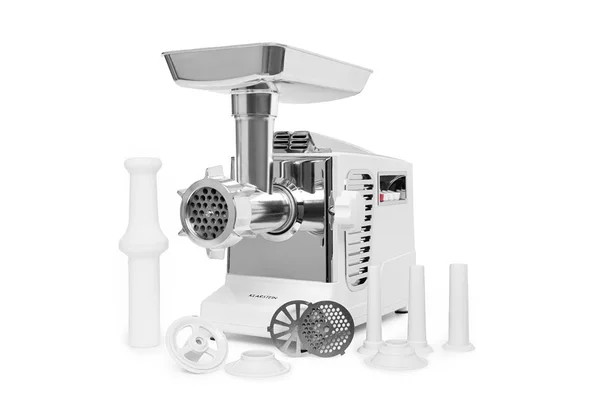 Photo: Klarstein, Amazon
The Klarstein Kraftprotz is a transparent budget choice that does not hide its power. It declares 700 W nominal and 1800 W locked power, so honestly, and it is driven by a copper motor. It has two speeds and a reverse function, an aluminium bowl, a stainless blade and a sausage attachment. For everyday grinding and the occasional sausage, that is quite enough at an affordable price.
Be realistic about the limits. The 700 W nominal power is good for ordinary meat, but not for large batches of game or very tough meat. And the accessory kit is more modest than on pro models. But as a transparent grinder that honestly says what it offers, the Klarstein is a smart choice for an average household.
| Specification | Detail |
|---|---|
| Power | 700 W nominal, 1800 W locked, copper motor |
| Reverse function | Yes, with 2 speeds |
| Plates and attachments | Stainless plates, sausage attachment, blade |
| Best for | A transparent budget for regular grinding |
Pros: An honestly declared nominal power (700 W) and transparent, a copper motor and a metal head for durability in its class, an affordable price with 2 speeds and reverse.
Cons: 700 W nominal is enough for everyday but not for large game, the accessory kit is more modest than pro models.
Our Opinion: The Kraftprotz is for those who value honesty in the specs. Instead of trumpeting a fake 2000 W, Klarstein says 700 W nominal and that is realistic. The copper motor is a plus at this price. For a family that grinds occasionally, quite enough.
4. Bosch ProPower MFW67440
 Photo: Bosch, Amazon
The Bosch ProPower MFW67440 is a more affordable Bosch that brings more accessories than its pricier sibling. The real power is 700 W, locked 2000 W, and again Bosch states both. What sets it apart is the rich set: three stainless plates, a sausage attachment, a tube (Kibbeh) attachment, a slicer (Durchlaufschnitzler) and a pusher. The reverse function and thermal motor protection are there as on other Bosch models.
The 700 W nominal power is lower than on the MFW68660, so for large batches or very tough meat look at a stronger model. And the body is plastic, though the grinding head is metal. But for those who want Bosch reliability and a Kibbeh attachment at a lower price, this is an excellent choice.
| Specification | Detail |
|---|---|
| Power | 700 W nominal, 2000 W locked |
| Reverse function | Yes (anti-jam) |
| Plates and attachments | 3 plates, sausage, Kibbeh, slicer, pusher |
| Best for | Bosch with a Kibbeh attachment |
Pros: Bosch reliability at a lower price than the MFW68660, 3 plates, a sausage attachment, Kibbeh and a slicer in the set, reverse function and thermal motor protection.
Cons: A lower nominal power (700 W) than pricier Bosch models, a plastic body though the head is metal.
Our Opinion: The MFW67440 is a smart choice when you want Bosch but also a Kibbeh attachment and a slicer in the package. You get more accessories than the pricier MFW68660 for less money, with the same reliability. Just know the motor is a bit weaker, so keep it for ordinary batches.
5. ProfiCook PC-FW 1272
 Photo: ProfiCook, Amazon
The ProfiCook PC-FW 1272 offers a sausage kit at a very low price. For 59,41 EUR you get three metal plates for coarse, medium and fine grinding, a sausage attachment and a cookie-dough attachment. The reverse function (forward and reverse) handles jams, and the neck and auger, the parts the meat passes through, are metal. The declared power is 1200 W, but that is the peak value, while the working power is lower.
As with other affordable grinders, the body is plastic, so it is less robust than metal housings. And take the power with a pinch of salt, since it is the maximum, not the working figure. But for someone who makes sausages occasionally and does not want to spend much, the ProfiCook gives a lot of accessories for little money.
| Specification | Detail |
|---|---|
| Power | 1200 W declared (peak), working lower |
| Reverse function | Yes (forward and reverse) |
| Plates and attachments | 3 metal plates, sausage, cookie dough |
| Best for | Sausages on a low budget |
Pros: A sausage and cookie kit at a very affordable price, 3 metal plates and a metal neck and auger, a reverse function to free a jam.
Cons: The declared power (1200 W) is peak and the working figure is lower, a plastic body is less robust than metal housings.
Our Opinion: The PC-FW 1272 is for those who want to try homemade sausages without a big investment. The metal neck and auger are a plus, and three plates cover all grinding degrees. Do not expect the robustness of Caso's metal, but for the price and occasional use the job is done.
6. Bomann FW 6067 CB
 Photo: Bomann, Amazon
The Bomann FW 6067 CB is the cheapest grinder on the list and an entry into the world of meat grinding. For just 33,99 EUR you get three metal plates for coarse, medium and fine grinding, a sausage attachment and a cookie-dough attachment. The reverse function is there, and the neck and auger are metal, which is a nice surprise at this price. The declared power is 1000 W as a peak value, while the working power is lower.
For the price, lower your expectations, especially about durability. In this class the main gear is prone to breaking with tough or frozen meat, so keep it for ordinary, boneless cuts. But as a first grinder for occasional use or a trial, the Bomann is hard to beat on price.
| Specification | Detail |
|---|---|
| Power | 1000 W declared (peak), working lower |
| Reverse function | Yes (forward and reverse) |
| Plates and attachments | 3 metal plates, sausage, cookie dough |
| Best for | Cheapest, a first grinder |
Pros: The lowest price on the list and an entry into grinding, a metal neck and auger and 3 metal plates, a reverse function and a sausage attachment.
Cons: The main gear in this class is prone to breaking with tough or frozen meat, the declared 1000 W power is peak and the working figure is lower.
Our Opinion: The Bomann is for those who want to try grinding without the risk of a big outlay. For 34 euros you get surprisingly much, including the metal parts the meat passes through. Just do not push it with sinews and bones, but use it for ordinary cuts.
7. STX Turboforce 3000
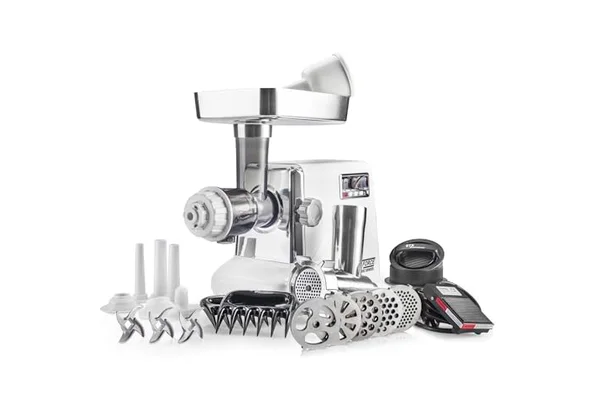 Photo: STX International, Amazon
The STX Turboforce 3000 is a professional grinder and the strongest on the list, meant for those who grind large batches and tough meat. Its main asset is metal gears, which handle game and tough meat without breaking, unlike the plastic in cheaper models. The declared 3000 W is a peak value, while the working figure is lower, but the motor is genuinely strong. There are three speeds with reverse, a foot pedal and a rich 7-in-1 set with five grinding plates, three blades and attachments for sausages and Kibbeh.
The only real downside is the price. At 514,51 EUR this is by far the most expensive grinder on the list, so it is not for an occasional user. But if you are a hunter, make large batches of sausages or need a grinder that will not break under load, the STX is the best at it.
| Specification | Detail |
|---|---|
| Power and speeds | 3000 W declared (peak), 3 speeds with reverse |
| Gears | Metal (for tough meat and game) |
| Plates and attachments | 7-in-1: 5 plates, 3 blades, sausage, Kibbeh |
| Best for | Game and large batches |
Pros: Metal gears and a strong motor and a first choice for game and tough meat, a rich 7-in-1 set with sausages and Kibbeh, a high capacity with 3 speeds and reverse.
Cons: Far more expensive than the rest of the list (professional price), the 3000 W declaration is peak and not working power.
Our Opinion: The STX is for serious users, hunters and those who grind large batches. The metal gears mean you will not break it with sinews or game. It is expensive and too big for an average kitchen, but if you grind a lot, it is a tool that will not let you down.
How to choose a meat grinder: power, reverse and material
Before you buy, it helps to understand a few things that separate a good choice from frustration. Meat grinders differ above all in real power, reverse and part materials. The best meat grinders for you depend on whether you grind occasionally or regularly, whether you make sausages and how tough the meat is.
Real power, not maximum
This is the most important thing and where meat grinders differ most. Makers often list a "maximum" or "locked" power, such as 2000 or 3000 W, while the real working nominal power is far lower, usually 300 to 880 W. That locked figure is what the motor briefly draws before it stops, not the working power. Honest brands, like Bosch, Caso and Klarstein, list both. For ordinary meat 500 to 800 W nominal is enough, and for large batches and game you need more.
Reverse function
The reverse function, marked reverse or Rücklauf, turns the auger backwards and frees a jammed sinew or tendon without taking the grinder apart. It is almost a must for comfortable grinding, since sinews and cartilage regularly block the auger. All the grinders on this list have reverse, and we warmly recommend it as one of the key criteria.
Metal or plastic parts
Durability depends on the material. A metal housing, like Caso's cast aluminium, is the most robust but heavier. Most have a plastic body with a metal grinding head, which is fine for home use. The gears matter most: metal ones handle tough meat, while plastic ones can break. Some models, like Bosch, deliberately have a plastic safety gear that breaks to protect the motor, so check whether it is replaceable.
Accessories: plates, sausages and Kibbeh
More accessories mean more options. Plates with different holes give coarse, medium or fine grinding. A sausage attachment (sausage stuffer) is a must for homemade sausages, and a tube attachment (Kibbeh) for stuffed rolls. Some kits add a grater, slicer or cookie attachment. If you plan sausages, check that the stuffing attachment is included.
Capacity and cleaning
Capacity is measured in kilograms per minute, and for home use about two kilograms is enough. After grinding the grinder needs taking apart and washing; metal parts are often dishwasher safe, but check the instructions. Fresh minced meat should be used right away or frozen for hygiene, since grinding increases the surface where bacteria develop.
Honest about the limits
Even the best meat grinders are not perfect. Cheap models overheat and their plastic gear can break with tough meat. Metal housings are heavier. Professional models like the STX are expensive and too big for an average kitchen. And almost all mislead with maximum power on the box. So decide first how much and what meat you grind, then choose by real power and material, not by the number on the box.
Conclusion
After comparing seven models, our recommendations depend on how much you grind and whether you make sausages. These are all good meat grinders, and the difference is in real power, reverse and part materials. The best meat grinders for you are the ones that match your use, not the ones with the most watts on the box.
| Who it's for | Recommendation | Price |
|---|---|---|
| Best overall | Bosch MFW68660 | 159,00 EUR |
| Value, metal housing | Caso FW2000 | 119,41 EUR |
| Transparent budget | Klarstein Kraftprotz | 95,99 EUR |
| Bosch with a Kibbeh attachment | Bosch ProPower MFW67440 | 139,99 EUR |
| Sausages on a low budget | ProfiCook PC-FW 1272 | 59,41 EUR |
| Cheapest | Bomann FW 6067 CB | 33,99 EUR |
| Game and large batches | STX Turboforce 3000 | 514,51 EUR |
For most households the Bosch MFW68660 is the safest choice because it joins honest power, service and versatility, while the Caso FW2000 offers a robust metal housing at a lower price. If you watch the budget, the Klarstein Kraftprotz states the power transparently, and the Bosch ProPower MFW67440 adds a Kibbeh attachment.
For homemade sausages on a small budget there are the ProfiCook PC-FW 1272 and the cheapest Bomann, and for serious batches and game the professional STX Turboforce 3000 with metal gears has no rival. Whatever you choose, look at the real nominal power and the reverse function, and use fresh minced meat right away or freeze it. Once you grind the meat, an electric grill or an induction cooktop will come in handy for cooking.
Frequently asked questions
What is the best meat grinder in 2026?
For most households the best is the Bosch MFW68660 because it joins honest power (880 W nominal), a reverse function, quality accessories and available service, for about 159 euros. If you watch the price, the Caso FW2000 offers a metal housing cheaper, and the Klarstein Kraftprotz is a transparent budget choice.
How much power does a meat grinder need?
Look at the real nominal power, not the maximum on the box. For ordinary meat 500 to 800 W nominal is enough. For large batches, very tough meat or game you need more and a stronger motor with metal gears. The marketing numbers of 2000 or 3000 W are locked peak power, not working power, so do not fall for them.
Can you make sausages on a meat grinder?
Yes, with a sausage attachment (sausage stuffer), which comes with most models on this list. The attachment goes on instead of a plate, and the meat is filled into sausage casing. Some models also have a tube (Kibbeh) attachment. If you plan sausages, check that the stuffing attachment is included before buying.
Metal or plastic meat grinder?
Metal parts are more durable. A metal housing, like cast aluminium, is the most robust, while a plastic body with a metal head is fine for home use. The gears matter most: metal ones handle tough meat, plastic ones can break. The exception is a deliberate plastic safety gear that breaks to protect the motor, so check whether it is replaceable.
How do you clean a meat grinder?
After use take the grinder apart, remove the meat residue and wash the plates, blade, auger and head. Metal parts are often dishwasher safe, but check the instructions since some wash better by hand. Dry the parts so they do not rust. Do not immerse the motor and body in water, but wipe them with a damp cloth.
What is the reverse function on a meat grinder for?
The reverse function, reverse or Rücklauf, turns the auger backwards and frees a jammed sinew, tendon or cartilage without taking the grinder apart. It is very useful because such parts of meat regularly jam and block the auger. That is why reverse is one of the key criteria in the choice, and all the grinders on this list have it.
How we chose
In selecting the best meat grinders we drew on German test portals that regularly test this category: Haus & Garten Test, ETM Testmagazin and CHIP.de, along with official data from makers Bosch, Caso, Klarstein and STX. We paid special attention to the real nominal power versus the marketing maximum, the reverse function and the part materials, because those are the things that most affect buyer satisfaction.
We chose only models available on Amazon.de with delivery to the EU, keeping a variety: mid-range from proven brands, metal housings, budget models, complete sausage sets and a professional grinder, priced from 34 to 515 euros. We rated each one by real power, reverse, gear and housing material, accessories and ease of cleaning. All prices are live from Amazon.de on 5 October 2026 and may change.
Sources and references
- Haus & Garten Test - meat grinder test: haus-garten-test.de
- ETM Testmagazin - meat grinders: etm-testmagazin.de
- CHIP.de - meat grinder comparison: chip.de
- Bosch - official site (MFW series): bosch-home.com
- Caso - official site: casodesign.de