


Property tax in Croatia (porez na nekretnine) is paid by owners of a flat or house where nobody lives permanently and which is not let on a long-term lease. It ranges from 0.60 to 8.00 euros per square metre of usable floor area per year, and each city or municipality sets the exact rate. For a 70 m² flat that means 42 to 560 euros a year. In Zagreb the rate rises from 5 to 8 euros per square metre on 1 January 2027, the legal maximum. Holiday homes, tourist apartments and empty flats pay; a flat you live in, or rent out for at least 10 months a year, does not.
This guide is for owners of flats, houses and holiday homes in Croatia, including foreign owners, who want to know whether they will get a tax assessment and how much they will pay. Property tax was introduced on 1 January 2025 by amendments to the Local Taxes Act (NN 152/24) and replaced the old holiday home tax. As of October 2026 the law has not changed and no amendment has been announced, so the same rules are expected to apply in 2027. Only the rates change in some cities, and councils can still change their decisions for 2027 until 15 December 2026.
Quick Overview: property tax in Croatia 2027
| # | What you need to know | In short |
|---|---|---|
| 1 | Who pays | The owner on 31 March |
| 2 | How much | 0.60 to 8.00 EUR/m² a year, depending on the city |
| 3 | How it is calculated | Usable floor area x rate per m² |
| 4 | Who is exempt | Permanent residence and eight other cases in the law |
| 5 | Long-term rental | Exempt if let for at least 10 months |
| 6 | Apartments and holiday homes | They pay, the flat-rate tax does not help |
| 7 | Deadlines and fines | Pay within 15 days of the assessment, fine up to 6,630 EUR |
1. Who pays property tax in Croatia
 Photo: Vladimir Srajber, Pexels
Property tax is paid by whoever owns the property on 31 March of the tax year. It does not matter whether the owner is Croatian or foreign, a person or a company. If the owner cannot be identified, the user pays. For new builds the obligation starts on the day the occupancy permit becomes final.
The tax applies to every residential building, flat and other self-contained space intended for living. It does not apply to farm buildings for machinery or to properties for which the utility fee (komunalna naknada) is charged at the business premises rate. Unlike the old holiday home tax, property tax is mandatory for every city and municipality. The money stays local: 80% goes to the city or municipality and 20% to the county.
| Situation | Is tax payable? |
|---|---|
| Flat you live in permanently | No |
| Flat let for 10+ months a year | No |
| Holiday home for your own use | Yes |
| Tourist apartment | Yes |
| Empty flat | Yes |
| Flat with utility fee at business rate | No (not taxable) |
Pros: the rules are the same throughout Croatia, and the flat you live in never pays
Cons: your situation is assessed as of 31 March, so buying or moving in after that date only counts from the following year
Our opinion: If you plan to move into a flat or let it out, do it and report it before 31 March. Any change after that date only counts for the tax authority from the next year.
2. Property tax rates by city
 Photo: Vladimir Srajber, Pexels
The law sets a range of 0.60 to 8.00 euros per m² of usable floor area. The city or municipal council chooses the rate within that range and may vary it by zone, settlement or street. If a council adopts no decision, the rate is 0.60 euros per m² and the Tax Administration collects it. The exception is local authorities that had a holiday home tax in 2024 and adopted no new decision: their previous rate still applies. The ceiling is higher than under the old holiday home tax, which went up to 5 euros.
According to the Tax Administration overview for 2026, 125 cities and municipalities apply the minimum of 0.60 euros and 84 charge between 5 and 8 euros. Compared with 2025, 41 local authorities raised the tax, 12 lowered it and 503 left it unchanged. The 8-euro maximum is mostly found in tourist towns on the coast, such as Umag, Fažana, Mali Lošinj, Nin and Biograd na Moru.
| City | 2025 | 2026 | 2027 |
|---|---|---|---|
| Zagreb | 5.00 | 5.00 | 8.00 (voted 16 Oct 2026) |
| Split | 1.99 | 5.00 | no change announced |
| Rijeka | 5.00 | 5.00 | no change announced |
| Osijek | 0.60 | 0.60 | no change announced |
| Zadar | 0.60 | 0.60 | proposal 5.00 / 3.00 / 2.00 by zone |
| Pula | 5.00 | 5.00 | no change announced |
| Dubrovnik | 0.60 to 5.00 by zone | 0.60 to 5.00 by zone | no change announced |
| Rovinj and Poreč | 6.25 | 6.25 | no change announced |
| Umag | 8.00 | 8.00 | no change announced |
Rates are in euros per m² per year. Zadar's proposal is in public consultation until 15 November 2026 and has not yet been adopted. Dubrovnik has five zones, from 5 euros in the inner centre to 0.60 euros for remote villages and the Elaphiti Islands.
Pros: towns with little tourism, such as Osijek and Varaždin, have kept the 0.60-euro minimum
Cons: rates can change every year, and Zagreb has voted to raise its rate by 60% in a single step from 2027
Our opinion: Before buying a flat to let or as a holiday home, check that city's decision, not the average. The difference between 0.60 and 8 euros per square metre on 70 m² is over 500 euros a year, every year.
3. How property tax is calculated: examples
 Photo: RDNE Stock project, Pexels
The calculation fits on one line: usable floor area in m² times the rate per m² in your city. The tax authority takes the floor area from the utility fee records, so the same number of square metres applies as on your utility fee bill. If that figure is wrong, report a correction by 31 March.
| Example | Rate per m² | Annual tax |
|---|---|---|
| 70 m² flat, Split, 2025 | 1.99 EUR | 139.30 EUR |
| 70 m² flat, Split, 2026 | 5.00 EUR | 350 EUR |
| 50 m² flat, Zagreb, 2026 | 5.00 EUR | 250 EUR |
| 50 m² flat, Zagreb, 2027 | 8.00 EUR | 400 EUR |
| 70 m² flat, Zagreb, 2027 | 8.00 EUR | 560 EUR |
| 50 m² holiday home, Hvar | 3.00 EUR | 150 EUR |
| 50 m² holiday home, Makarska | 5.00 EUR | 250 EUR |
| 50 m² holiday home, Umag | 8.00 EUR | 400 EUR |
A council may also increase the rate based on the age of the property and features that add to its value, but even then it cannot exceed 8 euros per m².
Pros: you can work out the tax yourself in advance, with no property valuation
Cons: the tax does not depend on market value, so a flat on the outskirts and one in the centre of the same size in the same zone pay the same
Our opinion: Check the floor area on your utility fee assessment. If the records show more square metres than the flat actually has, you are overpaying both the utility fee and property tax.
4. Who does not pay property tax: exemptions
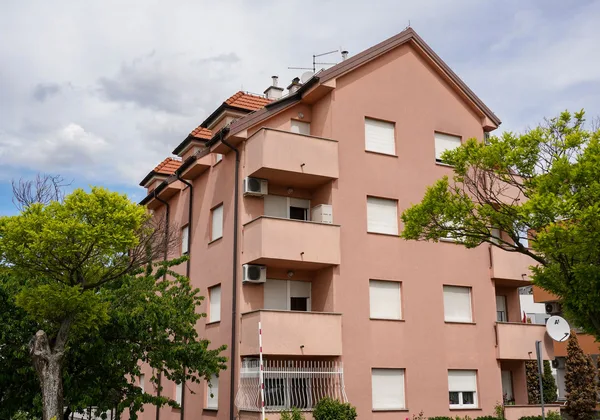 Photo: Vladimir Srajber, Pexels
The most important exemption is permanent residence. No tax is due even when someone else lives in the flat permanently, for example the owner's child or parent. A registered address alone is not sufficient proof, and the tax authority may check electricity and water consumption.
The law (Article 27) also exempts:
- properties let for permanent residence, for at least 10 months a year
- public-use properties and those used for institutional accommodation
- flats a company holds for sale, if less than 6 months have passed since they were entered in the books by 31 March
- properties taken over in lieu of unpaid debts, if less than 6 months have passed since the takeover by 31 March
- properties that cannot be used because of a declared natural disaster
- properties without utilities and without equipment replacing them (such as solar power or a water tank) that cannot be lived in, provided the owner proves it
- properties owned by the city or municipality within its own area
- a house where the host lives permanently while letting part of it to tourists
A city or municipality may also exempt socially vulnerable residents by its own decision. There is no special exemption for protected heritage buildings.
Pros: a flat where a family member lives is exempt even if the owner is not registered there
Cons: you must be able to prove the exemption, and for ruins and uninhabitable houses the burden of proof is on the owner
Our opinion: If your child or parent lives in your flat without a registered address, report it to the tax authority by 31 March. According to the Tax Administration, a family member living in the property was the most common reason for objections to the 2025 assessments as of March 2026.
5. Long-term rental: 10 months and a registered contract
 Photo: Gustavo Fring, Pexels
A flat you rent out as a home is exempt if it is let for at least 10 months in the year. The lease must be registered with the Tax Administration. Periods with different tenants add up, so two five-month leases meet the condition.
The owner cannot pass the tax on to the tenant by contract. A flat that a company rents to house its workers is also exempt, provided the people living there have a registered temporary address during the year.
Pros: long-term rental pays nothing, and a registered lease is also proof of the exemption
Cons: an unregistered lease does not count, and a flat that stood empty for three months does not meet the condition
Our opinion: The difference is large and worth working out before next season. In Zagreb from 2027 a 70 m² flat used for tourist rental pays 560 euros in property tax, while the same flat on a long-term lease pays nothing.
6. Apartments, holiday homes and empty flats pay
 Photo: Aakash Goel, Pexels
Property tax is payable on tourist apartments, regardless of the flat-rate income tax the host already pays. The law states explicitly that the flat-rate tax, other business taxes and registering non-commercial accommodation do not affect property tax. The exception is a house where the host lives permanently and lets only part of it.
Holiday homes where the owner stays occasionally and empty flats also pay. The tax authority identifies them from the utility fee records and by checking whether anyone has a registered address there. The City of Zagreb estimates that about 55,000 of its roughly 350,000 flats are empty, The city gave this as the main reason for raising the rate to 8 euros.
Pros: a house you live in permanently, letting only part of it to tourists, does not pay
Cons: hosts pay both the flat-rate tax and property tax, and in many tourist towns the rate is 5 euros per m² or more
Our opinion: Factor this tax into your 2027 apartment prices. For a 40 m² apartment in a town charging 8 euros, that is 320 euros a year. It is not a huge sum, but it comes back every year.
7. Assessment, payment deadline and fines
 Photo: cottonbro studio, Pexels
Property tax is set by a tax assessment (rješenje) based on the situation on 31 March. For most cities and municipalities, 386 of 556, assessments are issued by the Tax Administration, while others, such as Rijeka, issue them themselves. If you are exempt, you do not receive an assessment. For 2025, in the 386 local authorities it handles, the Tax Administration checked about 1.3 million properties and issued about 280,000 assessments in two rounds: from October 2025 and from February 2026.
Payment is due within 15 days of receiving the assessment. There is no fixed date. An objection does not postpone payment: if your objection succeeds, the money is refunded, and in the meantime the Tax Administration sends reminders. By May 2026 about 72,000 objections had been filed and more than 60,000 accepted. About 4,800 people who had paid without owing the tax got back around 800,000 euros.
Changes to your data and proof of exemption must be reported by 31 March, on the Tax Administration form or through ePorezna. If you pay the utility fee with correct data, or your lease is already registered, you do not need to send anything. The law sets a fine of 1,000 to 6,630 euros for failing to report data. Late payment incurs default interest, and debts are collected by enforcement.
Pros: most owners do not need to report anything, and in practice objections are often accepted
Cons: 15 days is a short deadline, and the fine for unreported data is many times higher than the tax itself
Our opinion: When an assessment arrives, first check the floor area and whether someone lives in the property. If the assessment is wrong, file an objection, but pay the tax on time anyway. That way you avoid interest, and any overpayment is refunded.
Conclusion: property tax in Croatia in 2027
The rules for property tax in 2027 stay the same. What changes is the price, and only in some cities. Zagreb goes to the maximum of 8 euros per m², Zadar proposes moving from the minimum to 2 to 5 euros by zone, and other cities can change their decisions until 15 December 2026.
| If your property is | What to do |
|---|---|
| A flat where you or a family member lives | Nothing if the address is registered; if not, report it by 31 March |
| On a long-term lease | Register the lease with the Tax Administration; the rental must last 10+ months |
| An apartment or holiday home | Check your city's 2027 rate and include it in your costs |
| An empty flat | You will pay, unless someone moves in before 31 March or you let it long-term (at least 10 months in the year) |
If you are planning to buy, see our guide to real estate investment in Croatia and the comparison of mortgages.
Frequently Asked Questions
Who pays property tax in Croatia?
Property tax in Croatia is paid by the owner of a residential property on 31 March, whether Croatian or foreign, a person or a company. It is not paid on a flat where someone lives permanently or on a flat let for at least 10 months a year. Holiday homes, tourist apartments and empty flats pay.
How much is property tax per square metre?
From 0.60 to 8.00 euros per m² of usable floor area per year, depending on the city or municipality. In 2026 Zagreb, Split, Rijeka and Pula charge 5 euros, Osijek and Zadar 0.60 euros, and Umag 8 euros. From 2027 Zagreb charges 8 euros per m².
Do I pay tax on the flat I live in?
No. The flat where you live permanently is exempt, as is a flat where a member of your family lives permanently. A registered address is not the only proof, and the tax authority may check electricity and water use. If nobody is registered at the address, report permanent residence by 31 March.
How can I avoid property tax?
Legally, by having someone live in the property permanently or by letting it on a long-term lease of at least 10 months a year, with the lease registered with the Tax Administration. No tax is due on a property without utilities, or equipment replacing them, that cannot be lived in either, but the owner must prove it.
When is property tax due?
Within 15 days of receiving the assessment. There is no fixed date in the year, because the tax authority sends assessments in several rounds. An objection does not postpone payment, so pay on time and wait for the decision on your objection. If it is accepted, the money is refunded.
What happens if I do not pay property tax?
Default interest is charged on the debt, and the Tax Administration sends a reminder and then starts enforcement, for amounts up to 660 euros, once the assessment is enforceable, it can have FINA collect directly from your bank accounts. A separate fine of 1,000 to 6,630 euros applies to anyone who fails to report the data needed to calculate the tax.
How we researched
We checked the rules in the consolidated text of the Local Taxes Act and in Tax Administration guidance. City rates come from the official Tax Administration table for 2025 and 2026 and from decisions and announcements by the cities of Zagreb, Rijeka, Zadar and Dubrovnik. Figures on assessments and objections come from the Tax Administration, as reported by Poslovni dnevnik and Index.hr. We checked the data on 19 October 2026. Cities can change their 2027 decisions until 15 December 2026, and we will update the table then.
Sources and references
- Local Taxes Act, consolidated text - zakon.hr
- NN 152/24 - amendments to the Local Taxes Act
- Tax Administration - property tax
- Tax Administration - property owners, reporting and objections
- Index.hr - Zagreb assembly raises property tax to the maximum
- City of Zadar - proposed new property tax rates
- City of Rijeka - decision on city taxes
- Poslovni.hr - 36,000 objections to property tax assessments
- Index.hr - Tax Administration accepted over 60,000 objections
- Index.hr - An objection does not postpone payment
Related articles
- Top 7 Real Estate Investment Tips for Croatia 2026
- Best Mortgages in Croatia 2026
- Best Home Insurance in Croatia 2026
- Top 7 Tax Refund Tips for Croatia 2026
Cover photo: Jakub Zerdzicki, Pexels