
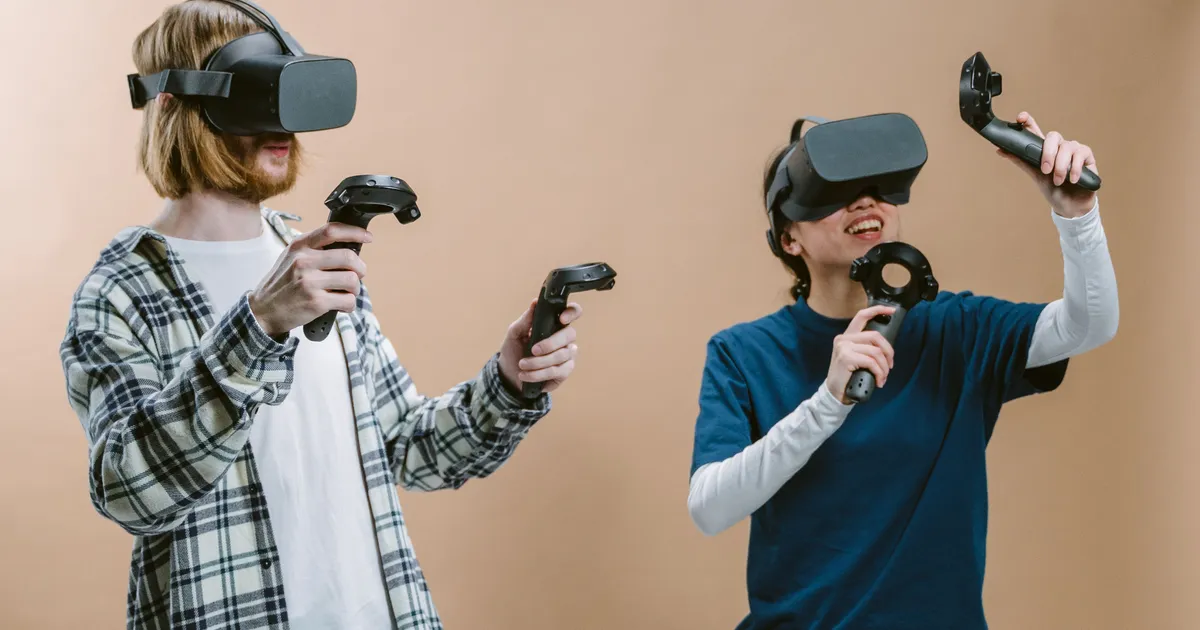

The VR headsets in this comparison cost from 348.90 euros for the Meta Quest 3S to 1,992.00 euros for the Pimax Crystal Super for PC on Amazon.de. This guide is for people buying their first VR headset for games, fitness or films, for PlayStation 5 owners and for sim racers and flight-sim fans with a powerful PC. The best VR headsets of 2027 are the Meta Quest 3 as the best choice for most people (599.99 euros), the Meta Quest 3S as the cheapest way into real virtual reality (348.90 euros) and the PlayStation VR2 for PS5 owners (434.00 euros). We compared seven models with live prices on 7 November 2026.
First decide where you'll play: standalone VR headsets work without a computer or cable, while PC and PS5 VR headsets need a device to render the image for them.
Quick overview: the best VR headsets of 2027
All VR headsets in this comparison are available on Amazon.de. Click a name to see the current price.
| Model | Type | Resolution per eye | Lenses | Weight | Price | Best for |
|---|---|---|---|---|---|---|
| Meta Quest 3 512 GB | standalone + PC | 2064 x 2208 | pancake | 515 g | €599.99 | Best overall |
| Meta Quest 3S 128 GB | standalone + PC | 1832 x 1920 | Fresnel | 514 g | €348.90 | Budget |
| PlayStation VR2 | PS5 (PC with adapter) | 2000 x 2040 OLED | Fresnel | 560 g | €434.00 | PS5 |
| PICO 4 Ultra | standalone + PC | 2160 x 2160 | pancake | 580 g | €699.95 | No Meta |
| HTC Vive Focus Vision | standalone + PC | 2448 x 2448 | Fresnel | 785 g | €1,199.00 | Eye tracking |
| Pimax Crystal Light | PC | 2880 x 2880 | aspheric glass | 815 g | €1,236.00 | Sims |
| Pimax Crystal Super | PC | 3840 x 3840 | aspheric glass | about 966 g | €1,992.00 | Enthusiasts |
Data comes from the official websites of Meta, Sony, PICO, HTC and Pimax and from Road to VR and PC Gamer reviews.
How to choose a VR headset
Standalone, PC or console
Standalone VR headsets such as the Meta Quest, PICO and HTC Vive Focus Vision have their own processor and battery, so you play without a cable anywhere in your home. Most of them can also connect to a computer for more demanding PC games through SteamVR. The PlayStation VR2 only works with a PS5 or, with an adapter, a computer. Pimax headsets are PC-only and need a powerful graphics card, but they give the sharpest image for racing and flight sims.
Age limits
Meta allows children from 10 to use Quest, but from 10 to 12 only through a parent-managed account, and from 13 a child can have their own account (Meta). Sony says the PlayStation VR2 is not for children under 12 (PlayStation). For PICO, HTC and Pimax, check the maker's safety instructions.
Motion sickness in VR
Motion sickness happens when your eyes see movement your inner ear doesn't feel, and latency and dropped frames make it worse (IxDF). A steady 90 or 120 Hz helps, as do teleport and snap turning instead of smooth movement, and the comfort vignette that many games offer in their settings. Start with short sessions of about ten minutes, stationary games and fresh air or a fan.
How much space you need
For room-scale play Meta recommends at least 2 x 2 m of clear space, and in a smaller room there's a stationary mode with a default 1 x 1 m boundary, seated or standing (Meta). Move coffee tables, lamps and pets out of the play area, because with VR headsets on you can't see what's around you.
Prescription glasses
Meta says glasses with frames up to 142 mm wide and 50 mm high fit in a Quest (Meta). The Quest 3 has lens depth adjustment, and the Quest 3S comes with a glasses spacer. For more comfortable play there are prescription lens inserts that fit in front of the VR headset's lenses, and Meta recommends those from Zenni (Meta). Quest 3 and 3S inserts aren't interchangeable.
Meta account and Facebook
Since August 2022 Quest requires a Meta account, and a Facebook account is no longer required, with linking optional (Road to VR). If you don't want any Meta account, PICO or HTC VR headsets are the alternative.
1. Meta Quest 3 512 GB
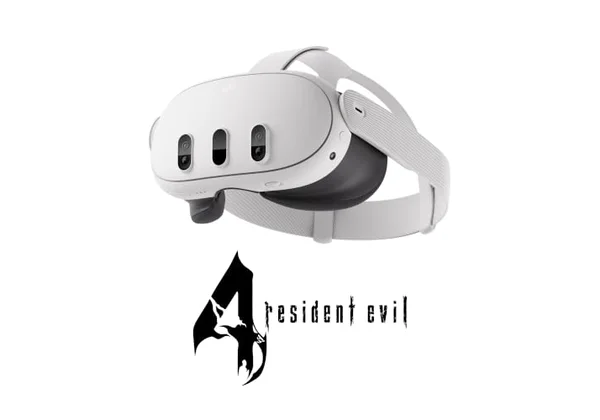 Photo: Meta, Amazon
The Meta Quest 3 is the headset reviewers in 2026 still most often recommend for most people (Engadget). Its LCD panels have 2064 x 2208 pixels per eye at up to 120 Hz, and pancake lenses give a sharp image from centre to edge across a 110-degree field of view. The Snapdragon XR2 Gen 2 and 8 GB of RAM run the largest library of standalone VR games.
Colour cameras and a depth sensor, which the 3S lacks, enable mixed reality, so you see virtual objects in your own room. Lens spacing adjusts continuously from 53 to 75 mm, and through Link or Air Link the Quest also works as a PC VR headset. The battery lasts about 2.2 hours, and the standard strap is uncomfortable for longer sessions. On Amazon.de this version comes with Resident Evil 4.
| Feature | Detail |
|---|---|
| Display | LCD, 2064 x 2208 per eye |
| Refresh rate | up to 120 Hz |
| Field of view | 110° |
| Lenses | pancake |
| Chip | Snapdragon XR2 Gen 2, 8 GB RAM |
| Storage | 512 GB |
| Battery | about 2.2 h |
| Weight | 515 g |
| Price | €599.99 |
Pros: sharp pancake lenses, mixed reality with a depth sensor, largest game library, also works with a PC, wide lens adjustment range.
Cons: battery only about 2.2 hours, uncomfortable standard strap, requires a Meta account.
Our opinion: If you're buying one VR headset for games, fitness and films, get the Quest 3. For 250 euros more than the 3S you get pancake lenses, and you notice their sharpness in every game.
2. Meta Quest 3S 128 GB
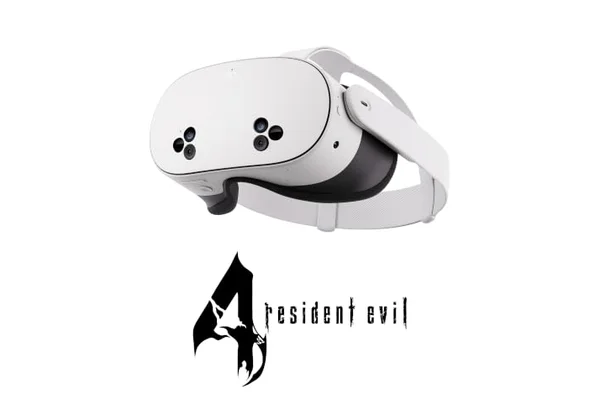 Photo: Meta, Amazon
At 348.90 euros, the Quest 3S is the cheapest way into real standalone virtual reality in the comparison, with the same XR2 Gen 2 chip and 8 GB of RAM as the Quest 3 and the same game library. The savings show in the optics: Fresnel lenses have a smaller sweet spot, the field of view is 96 degrees and resolution is 1832 x 1920 per eye. Lens spacing has only three positions, 58, 63 and 68 mm.
The battery lasts about 2.5 hours, slightly longer than the Quest 3, and a side button quickly switches to a view of the room. A glasses spacer is included. The 128 GB version fills up fast, and the 256 GB version is currently unavailable on Amazon.de. This version also comes with Resident Evil 4.
| Feature | Detail |
|---|---|
| Display | LCD, 1832 x 1920 per eye |
| Refresh rate | up to 120 Hz |
| Field of view | 96° |
| Lenses | Fresnel |
| Chip | Snapdragon XR2 Gen 2, 8 GB RAM |
| Storage | 128 GB |
| Battery | about 2.5 h |
| Weight | 514 g |
| Price | €348.90 |
Pros: lowest price for real standalone VR, same chip and games as Quest 3, slightly longer battery, glasses spacer.
Cons: Fresnel lenses with a smaller sweet spot, narrower field of view, only three lens positions, 128 GB.
Our opinion: The Quest 3S is the VR headset for a first taste of virtual reality and for families with children from 10. If you know you'll play every day, save a little more and get the Quest 3.
3. PlayStation VR2
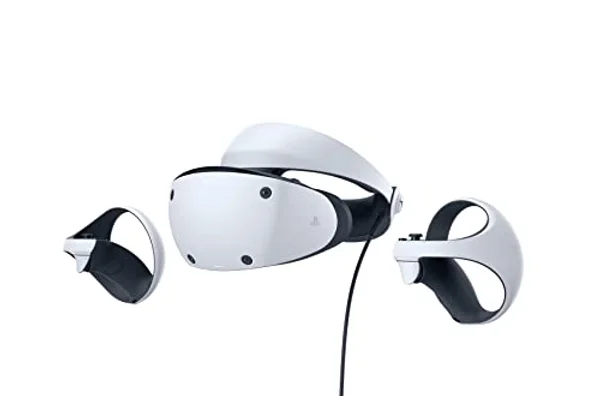 Photo: Sony, Amazon
The PlayStation VR2 is the PS5 headset with OLED HDR panels at 2000 x 2040 pixels per eye, which give deeper blacks and better contrast than the LCDs in a Quest. It has eye tracking with foveated rendering, headset haptics and Sense controllers with adaptive triggers. It connects to the PS5 with a single USB-C cable, and the field of view is about 110 degrees.
Since August 2024 Sony has sold a 59.99 euro PC adapter that lets the PS VR2 work with SteamVR. On PC there's no HDR, eye tracking, headset haptics or adaptive triggers, and you also need a DisplayPort 1.4 cable, which isn't included (Push Square). The lenses are Fresnel, and the camera view is black and white, with no real mixed reality.
| Feature | Detail |
|---|---|
| Display | OLED HDR, 2000 x 2040 per eye |
| Refresh rate | 90 / 120 Hz |
| Field of view | about 110° |
| Lenses | Fresnel |
| Eye tracking | yes |
| Connection | PS5 (USB-C), PC with adapter |
| Weight | 560 g |
| Price | €434.00 |
Pros: OLED HDR image, eye tracking, PS5 exclusive games, single cable to the console, also works with a PC.
Cons: needs a PS5 or a PC with an adapter, wired, Fresnel lenses, loses most special features on PC.
Our opinion: If you already own a PS5, the PS VR2 is the cheapest route to VR with an OLED display. On Amazon.de, choose the version sold new by Amazon, because some other offers are sold as returned goods.
4. PICO 4 Ultra
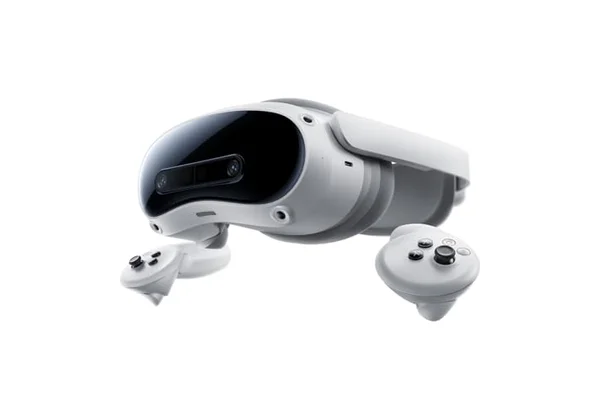 Photo: PICO, Amazon
Anyone who doesn't want a Meta account but wants standalone VR headsets looks at the PICO 4 Ultra. It has the same XR2 Gen 2 chip as the Quest 3, but 12 GB of RAM and 256 GB of storage, LCD panels at 2160 x 2160 pixels per eye and pancake lenses with a 105-degree field of view (PICO). The battery sits at the back of the strap, so the weight is better balanced.
32 MP cameras give a colour view of the room and mixed reality, and Wi-Fi 7 helps with streaming PC games. The refresh rate tops out at 90 Hz, and the game library is smaller than Meta's. On Amazon.de it's sold by a third-party seller with low stock and an unusual listing title, so check what's in the box before you buy.
| Feature | Detail |
|---|---|
| Display | LCD, 2160 x 2160 per eye |
| Refresh rate | up to 90 Hz |
| Field of view | 105° |
| Lenses | pancake |
| Chip | Snapdragon XR2 Gen 2, 12 GB RAM |
| Storage | 256 GB |
| Weight | 580 g |
| Price | €699.95 |
Pros: no Meta account, 12 GB of RAM and 256 GB, pancake lenses, balanced weight, Wi-Fi 7.
Cons: smaller game library, only 90 Hz, only from a third-party seller on Amazon.de and pricier than the Quest 3.
Our opinion: The PICO 4 Ultra makes sense if staying out of Meta's ecosystem matters to you or you mainly play PC games. Otherwise the Quest 3 gives you more games for 100 euros less.
5. HTC Vive Focus Vision
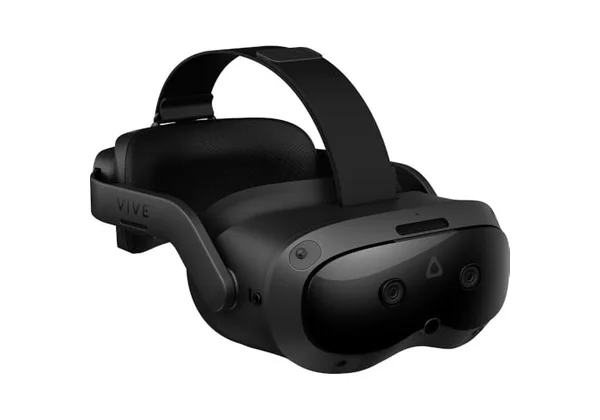 Photo: HTC, Amazon
Among the standalone models in the comparison, the HTC Vive Focus Vision has the highest resolution, 2448 x 2448 pixels per eye, and a field of view of up to 120 degrees (HTC). It has eye tracking, automatic lens spacing from 57 to 72 mm and a rear battery you can swap without powering off.
With an extra wired streaming kit it works as a true PC VR headset over DisplayPort. The chip is the older XR2 Gen 1, and at 785 g it's heavier than a Quest. The lenses are Fresnel, and a microSD slot expands the 128 GB of storage. On Amazon.de it's sold by Amazon, but with a longer delivery time.
| Feature | Detail |
|---|---|
| Display | LCD, 2448 x 2448 per eye |
| Refresh rate | 90 Hz (120 Hz over DisplayPort, beta) |
| Field of view | up to 120° |
| Lenses | Fresnel |
| Eye tracking | yes |
| Battery | up to 2 h, swappable |
| Weight | 785 g |
| Price | €1,199.00 |
Pros: highest resolution among standalones, eye tracking, automatic lens spacing, swappable battery, real PC mode.
Cons: older chip, heavy at 785 g, Fresnel lenses, expensive, PC kit costs extra.
Our opinion: The Focus Vision is for people who want one headset for standalone play and serious PC VR without Meta. For most gamers the Quest 3 gives more for half the price.
6. Pimax Crystal Light
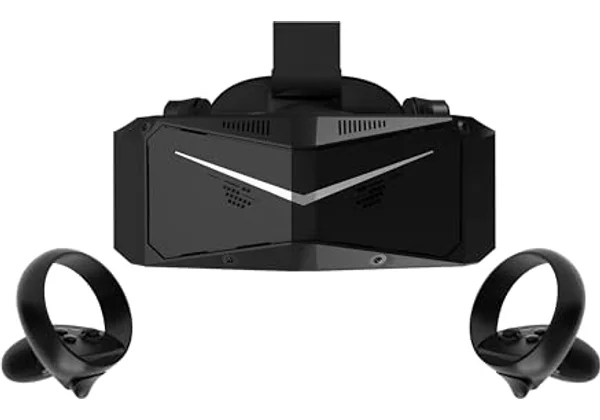 Photo: Pimax, Amazon
The Pimax Crystal Light is a PC VR headset with 2880 x 2880 pixels per eye and aspheric glass lenses, which give a very sharp image and a large sweet spot (Pimax). That makes it a favourite of sim racers and flight-sim players, who need to read the instruments in the cockpit. The refresh rate goes up to 120 Hz, and tracking uses cameras, with no base stations.
Pimax requires at least an RTX 2080 graphics card and recommends an RTX 3070 or better. It weighs about 815 g, so it gets heavy in long sessions. This version comes with controllers, and Pimax's software is less polished than Meta's. There's no standalone mode.
| Feature | Detail |
|---|---|
| Display | 2880 x 2880 per eye |
| Refresh rate | up to 120 Hz |
| Lenses | aspheric glass |
| Tracking | cameras, no base stations |
| Graphics card | at least RTX 2080, RTX 3070 recommended |
| Lens spacing | 58-72 mm |
| Weight | about 815 g |
| Price | €1,236.00 |
Pros: very sharp image for sims, glass lenses, 120 Hz, no base stations, controllers included.
Cons: heavy, needs a powerful PC, no standalone mode, less polished software.
Our opinion: If you play racing or flight sims and have a strong graphics card, the Crystal Light gives the most sharpness for the money.
7. Pimax Crystal Super
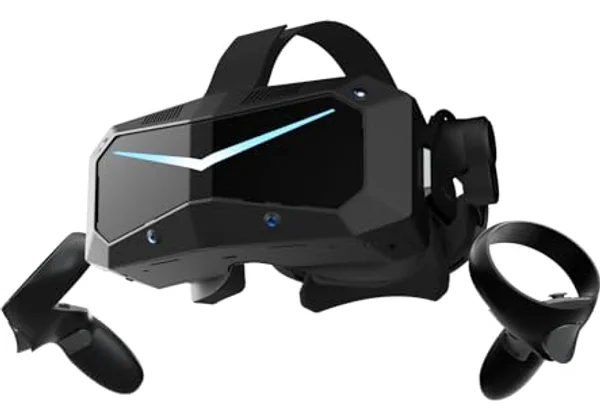 Photo: Pimax, Amazon
The sharpest image in the comparison comes from the Pimax Crystal Super for PC: 3840 x 3840 pixels per eye and, depending on the optical engine, 50 to 57 pixels per degree (PC Gamer). It has eye tracking with foveated rendering, swappable optical engines and a very wide field of view.
For that resolution you need a top-end graphics card, and Pimax lists cards from RTX 3070 to RTX 4090 depending on settings, while reviewers recommend a very powerful one. Available data puts its weight at about 966 g, making it the heaviest headset in the comparison, and reviewers also mention software bugs. On Amazon.de, choose the full-payment version, not the part-payment one, and check whether controllers are in the box.
| Feature | Detail |
|---|---|
| Display | 3840 x 3840 per eye |
| Sharpness | 50-57 pixels per degree |
| Refresh rate | 72 / 90 Hz |
| Lenses | aspheric glass, swappable engines |
| Eye tracking | yes |
| Graphics card | top-end (RTX 3070 to RTX 4090) |
| Weight | about 966 g |
| Price | €1,992.00 |
Pros: sharpest image in the comparison, wide field of view, eye tracking, swappable optical engines.
Cons: almost 1 kg, needs a top-end PC, most expensive in the comparison, software bugs.
Our opinion: The Crystal Super is for enthusiasts who already have a sim cockpit and a 1,000 euro graphics card. For everyone else the Crystal Light gives most of it for 750 euros less.
Conclusion: which VR headset to choose?
For most people the best choice is the Meta Quest 3: standalone, with pancake lenses, a depth sensor for mixed reality and the most games for 599.99 euros. On a smaller budget the Quest 3S gives you the same games for 348.90 euros, and PS5 owners get an OLED image with the PlayStation VR2 for 434.00 euros. The PICO 4 Ultra and HTC Vive Focus Vision are for those who don't want Meta's ecosystem, and the Pimax Crystal Light and Super are for sims on a powerful PC. Choose VR headsets by where and what you'll play first, and by resolution second.
| If what matters most is | Choose | Price |
|---|---|---|
| Best overall | Meta Quest 3 512 GB | €599.99 |
| Lowest price | Meta Quest 3S 128 GB | €348.90 |
| I own a PS5 | PlayStation VR2 | €434.00 |
| No Meta account | PICO 4 Ultra | €699.95 |
| Eye tracking, standalone + PC | HTC Vive Focus Vision | €1,199.00 |
| Sims on a sensible budget | Pimax Crystal Light | €1,236.00 |
| Sharpest image | Pimax Crystal Super | €1,992.00 |
PC VR needs a powerful computer, so see our gaming laptops, and for gaming on the go our portable gaming consoles. If you're interested in glasses for everyday wear, see our smart glasses.
Frequently asked questions
What age are VR headsets for?
Meta allows Quest from age 10, but from 10 to 12 only through a parent-managed account. Sony says the PlayStation VR2 is not for children under 12. For other makers, check the safety instructions and limit play time.
Do VR headsets need a computer or console?
Standalone VR headsets such as the Meta Quest 3 and 3S, PICO 4 Ultra and HTC Vive Focus Vision work without a computer. The PlayStation VR2 needs a PS5 or a computer with an adapter, and Pimax headsets only work with a computer with a powerful graphics card.
How do you avoid motion sickness in VR?
Play at 90 or 120 Hz, choose teleport and snap turning instead of smooth movement, and turn on the comfort vignette. Start with short sessions of about ten minutes, take breaks and play with fresh air. Don't play when you're tired.
Can I wear prescription glasses under a VR headset?
Frames up to 142 mm wide and 50 mm high fit in a Meta Quest, and the Quest 3S comes with a glasses spacer. Prescription lens inserts that fit into the VR headset are more comfortable, and Meta recommends those from Zenni.
How much space do you need for VR?
For room-scale play Meta recommends at least 2 x 2 m of clear space. In a smaller room use stationary mode, seated or standing, with a default 1 x 1 m boundary. Move objects and pets out of the play area.
Do you need a Facebook account for a Meta Quest?
No. Since August 2022 Quest uses a Meta account, and linking Facebook or Instagram is optional. If you don't want any Meta account, choose PICO or HTC.
How long does a VR headset battery last?
The Meta Quest 3 lasts about 2.2 hours and the Quest 3S about 2.5 hours. The HTC Vive Focus Vision lasts up to 2 hours, but you can swap its battery without powering off. The PlayStation VR2 and Pimax headsets have no battery because they're wired.
How we chose
The VR headsets in this comparison were chosen by type (standalone, PC, console), resolution, lenses, field of view, eye tracking, weight, game library and price. We looked at around fifteen models, of which the Valve Steam Frame, Bigscreen Beyond, Apple Vision Pro and Samsung Galaxy XR aren't sold on Amazon.de, and from the rest we only took new offers, not returned goods. We checked every ASIN through the Amazon API. Data comes from the official websites of Meta, Sony, PICO, HTC and Pimax and from Road to VR, Engadget and PC Gamer reviews. Prices are live Amazon.de prices on 7 November 2026. We did not test the headsets ourselves.
Sources and references
- Road to VR - Quest 3S, Quest 3 and Quest 2 specs compared
- Engadget - best VR headsets 2026
- PlayStation - PS VR2 tech specs
- PlayStation - PS VR2 safety
- Push Square - PS VR2 PC adapter
- PICO - PICO 4 Ultra specs
- HTC - Vive Focus Vision specs
- Pimax - Crystal Light
- PC Gamer - Pimax Crystal Super review
- Meta - age requirements
- Meta - play space
- Meta - glasses in Quest
- Meta - prescription lens inserts
- Road to VR - Meta accounts replace Facebook logins
- IxDF - cybersickness in virtual reality
Related articles: