


The UPS devices in this comparison cost from 89.17 euros for the APC Back-UPS BX750MI-GR to 611.07 euros for the APC Smart-UPS SMC1500IC on Amazon.de. This guide is for anyone who wants a router, a computer or a gas boiler to keep running when the power goes out, but isn't sure how many VA they need or whether they need a pure sine wave. The best UPS devices of 2027 are the APC Back-UPS BX750MI-GR as a cheap pick for a router and fibre terminal, the Green Cell PowerProof 1000VA as the most affordable pure sine wave unit with Schuko outlets (139.00 euros) and the CyberPower OLS1000EA-DE as an affordable true online UPS from a major brand (277.74 euros). We compared seven models with live prices as of 11 November 2026.
Before buying, decide what you will plug in, because UPS devices are not all the same. A router needs only the smallest UPS. A gas boiler with a circulation pump and a computer with a modern power supply need a pure sine wave UPS.
Quick overview: best UPS devices 2027
All UPS devices in this comparison are available on Amazon.de. Click a name to see the current price.
| Model | Power | Type | Waveform | Outlets | Price | Best for |
|---|---|---|---|---|---|---|
| APC Back-UPS BX750MI-GR | 750 VA / 410 W | line-interactive | simulated | 4x Schuko | 89.17 € | Router, ONT, cameras |
| Eaton 5E Gen2 5E1200UD | 1200 VA / 660 W | line-interactive | simulated | 4x Schuko | 185.10 € | Home office |
| Green Cell PowerProof 1000VA | 1000 VA / 700 W | line-interactive | pure sine | Schuko | 139.00 € | Boiler on a budget |
| PowerWalker VI 1000 CSW | 1000 VA / 600 W | line-interactive | pure sine | 4x Schuko | 196.84 € | Boiler and pump |
| CyberPower CP1200EIPFCLCD | 1200 VA / 720 W | line-interactive | pure sine | 2x Schuko + 4x IEC | 275.07 € | Gaming PC |
| CyberPower OLS1000EA-DE | 1000 VA / 900 W | online | pure sine | 2x Schuko + 1x IEC | 277.74 € | Sensitive equipment |
| APC Smart-UPS SMC1500IC | 1500 VA / 900 W | line-interactive | pure sine | 8x IEC | 611.07 € | Small office, NAS |
Data comes from the manufacturers and Amazon.de listings. We found no recent group test of UPS devices (Stiftung Warentest, c't, Computerbild), so we rely on manufacturer data and individual reviews.
How to choose a UPS
VA vs W: what size UPS you need
VA is apparent power and W is the real power the UPS can deliver. Cheaper line-interactive UPS devices have a power factor of around 0.55 to 0.6, so the APC BX750MI-GR is rated 750 VA but only 410 W. Online models have a factor of 0.8 to 0.9, so the CyberPower OLS1000EA-DE delivers 900 W from 1000 VA (CyberPower).
UPS devices are sized in watts. Add up the wattage of everything you plug in and add 20 to 30 % headroom. A router and ONT draw 10 to 20 W, while a gaming PC with a monitor can pull 400 W or more under load. Read the boiler and pump wattage from the rating plate.
Line-interactive or online
A line-interactive UPS passes mains power through an AVR, which corrects under- and overvoltage without draining the battery. When the power fails, it switches to battery in 6 to 10 ms. An online (double-conversion) UPS constantly converts AC to DC and back, so the transfer time is 0 ms (Sikich). The price is a fan that always runs and somewhat higher consumption.
Most home users don't need an online model: line-interactive UPS devices are enough for a computer and router. An online UPS makes sense with an unstable grid and sensitive equipment.
Pure sine wave for a gas boiler and pump
Cheaper UPS devices output a simulated (stepped) sine wave on battery. Schneider Electric says this waveform on Back-UPS units is meant for computer loads and is "not particularly compatible with most motor loads" (Schneider Electric). A pump motor may then run slowly, unevenly or not at all.
So for a gas boiler with a circulation pump, choose UPS devices with a pure sine wave; in this comparison they start at 139 euros. We found no official recommendation from boiler makers, so check your boiler's manual. If the boiler is hard-wired without a plug, only an electrician should connect it to a UPS.
Runtime and battery
A rough runtime estimate: battery energy in Wh times 0.85, divided by the load in watts. Two 12 V 7 Ah batteries hold 168 Wh, so an 80 W boiler would in theory run about 1.8 hours. In practice it's less, because lead-acid batteries lose capacity under fast discharge and with age (solaranlage-tipps.de).
According to APC, a VRLA battery lasts 3 to 5 years at 25 °C, and every 8 °C above that halves its life (Schneider Electric). Don't put the UPS next to a radiator.
What not to plug in
Don't connect a laser printer to either the battery or the surge-only outlets of a UPS, because the high draw when it heats up can overload the UPS (APC). Heaters, kettles and hair dryers draw 1500 to 2000 W, more than most home UPS devices can handle. Don't daisy-chain one UPS into another either.
1. APC Back-UPS BX750MI-GR
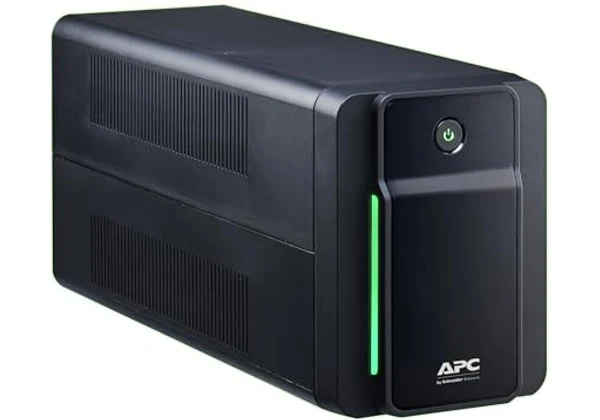 Photo: APC, Amazon
The APC Back-UPS BX750MI-GR is a small 750 VA, 410 W line-interactive UPS with four Schuko outlets. It has AVR and a 6 ms transfer time. The series datasheet gives about 8.5 minutes at half load and about one minute at full load (datasheet).
A router, ONT and Wi-Fi mesh draw little, so on this UPS they can run for an hour or more (estimate). On battery it outputs a simulated sine wave, so it's not for a gas boiler or a pump.
| Feature | Detail |
|---|---|
| Power | 750 VA / 410 W |
| Type | line-interactive, AVR |
| Waveform | simulated sine wave |
| Outlets | 4x Schuko |
| Runtime | 8.5 min at half load |
| Transfer time | 6 ms |
| Price | 89.17 € |
Pros: affordable APC with Schuko outlets, compact and quiet, AVR saves the battery.
Cons: simulated sine wave, only 410 W, short runtime at full load.
Our opinion: This is the UPS we would put next to the router and fibre terminal. When the power goes out, Wi-Fi keeps working and your phone and laptop stay online.
2. Eaton 5E Gen2 5E1200UD
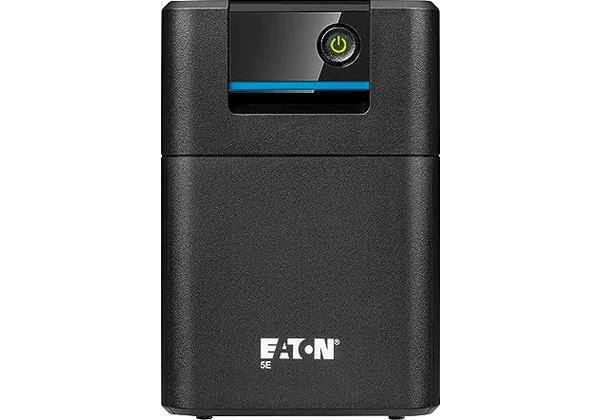 Photo: Eaton, Amazon
The Eaton 5E Gen2 5E1200UD delivers 1200 VA and 660 W with four Schuko outlets for under 200 euros. It has AVR, USB and a wide 140 to 300 V input range, and Eaton quotes efficiency of up to 95 % (Eaton). Inside are two 12 V 7 Ah batteries.
For a home office with a computer, monitor and router you get a lot of watts for the money. On battery it outputs a stepped sine wave, there's no display, and Eaton gives the exact runtime only as a graph.
| Feature | Detail |
|---|---|
| Power | 1200 VA / 660 W |
| Type | line-interactive, AVR |
| Waveform | simulated sine wave |
| Outlets | 4x Schuko |
| Battery | 2x 12 V / 7 Ah |
| Ports | USB |
| Price | 185.10 € |
Pros: 660 W under 200 euros, Schuko outlets, wide input range.
Cons: simulated sine wave, no display.
Our opinion: The 5E1200UD is a good choice for a computer with a standard power supply. For a PC with active PFC under heavy load, get a pure sine wave model.
3. Green Cell PowerProof 1000VA
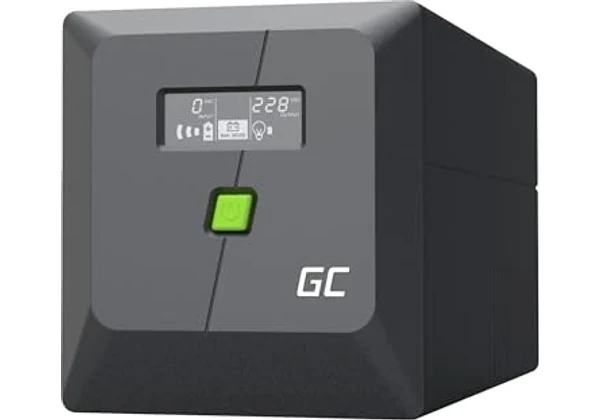 Photo: Green Cell, Amazon
The Green Cell PowerProof 1000VA is a line-interactive pure sine wave UPS rated 1000 VA and 700 W. It has an LCD display, AVR, USB and RJ45 network line protection, plus two 12 V 7 Ah AGM batteries. The input range is 162 to 290 V (x-kom).
At 139 euros it's the cheapest pure sine wave unit in this comparison, and 700 W covers a gas boiler with a pump. The model is new, so there are few independent reviews yet. The outlet layout differs between variants, so check it in the listing.
| Feature | Detail |
|---|---|
| Power | 1000 VA / 700 W |
| Type | line-interactive, AVR |
| Waveform | pure sine wave |
| Outlets | Schuko (check variant) |
| Battery | 2x 12 V / 7 Ah AGM |
| Ports | USB, RJ45 protection, LCD |
| Price | 139.00 € |
Pros: cheapest pure sine wave, 700 W, LCD showing the load.
Cons: few independent reviews, specifications vary by variant.
Our opinion: For a boiler on a budget, it's hard to find a better deal. Just make sure you add the pure sine wave version to your cart, because Green Cell also sells cheaper PowerProof models without it.
4. PowerWalker VI 1000 CSW
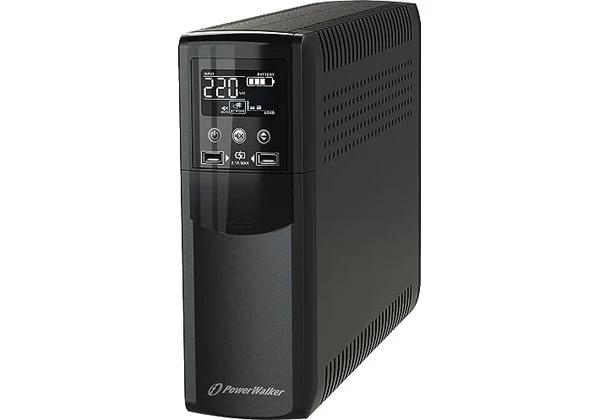 Photo: PowerWalker, Amazon
The PowerWalker VI 1000 CSW from BlueWalker delivers 1000 VA and 600 W with a pure sine wave and four Schuko outlets. It has two USB chargers on the front, a battery (12 V 10 Ah according to retailers) that can be swapped from the front, and a 10 ms transfer time (Digitec).
Runtime at full load is only about 2.2 minutes, but a boiler draws far less than 600 W. There is also a separate IEC version, so check that the listing is the Schuko one.
| Feature | Detail |
|---|---|
| Power | 1000 VA / 600 W |
| Type | line-interactive, AVR |
| Waveform | pure sine wave |
| Outlets | 4x Schuko |
| Battery | 12 V / 10 Ah |
| Noise | 40 dB |
| Price | 196.84 € |
Pros: pure sine wave and Schuko, front-swappable battery, USB chargers.
Cons: only 600 W, short runtime at full load.
Our opinion: About 58 euros more than the Green Cell, and in return a model that has been on the market for years. We would pick it if you don't want to take a chance on a new model.
5. CyberPower CP1200EIPFCLCD
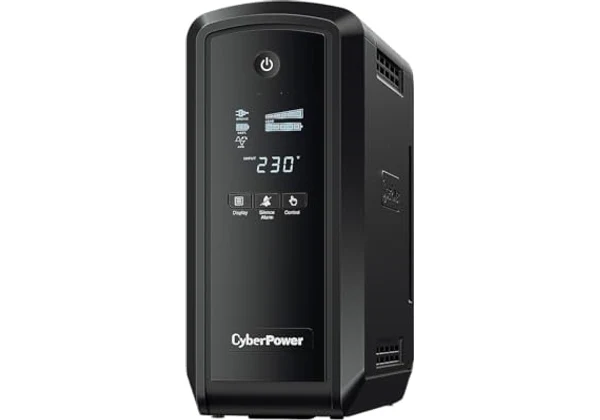 Photo: CyberPower, Amazon
The CyberPower CP1200EIPFCLCD delivers 1200 VA and 720 W with a pure sine wave and works with active PFC power supplies. It has six outlets on battery (two Schuko and four IEC C13), a tilting colour LCD, USB and 1 Gbit network protection. CyberPower quotes 11.4 minutes at half load and 3.1 minutes at full load (CyberPower).
It belongs to the same PFC Sinewave series as the CP1500EPFCLCD, which Allround-PC recommended in 2021 and measured at about 10 minutes at 390 W (Allround-PC). For a gaming PC or workstation, this is the model we would choose.
| Feature | Detail |
|---|---|
| Power | 1200 VA / 720 W |
| Type | line-interactive, AVR |
| Waveform | pure sine wave, active PFC |
| Outlets | 2x Schuko + 4x IEC C13 |
| Runtime | 11.4 min at half load |
| Transfer time | 8 ms |
| Price | 275.07 € |
Pros: pure sine wave and 720 W, colour LCD, extensive management.
Cons: only two Schuko outlets, pricier than the Green Cell.
Our opinion: For a gaming PC, this is our pick. One small catch: four of the six outlets are IEC, so devices with a Schuko plug need an IEC cable (C14) there.
6. CyberPower OLS1000EA-DE
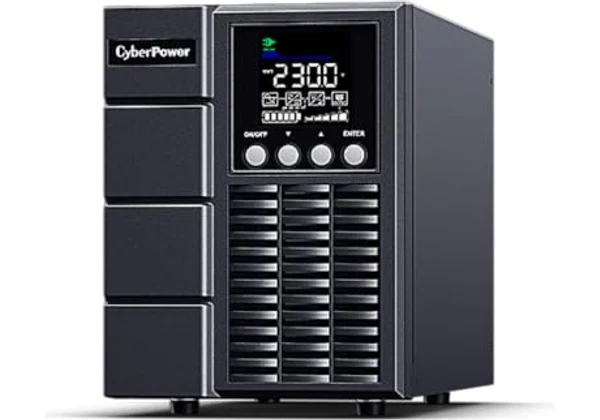 Photo: CyberPower, Amazon
The CyberPower OLS1000EA-DE is an online double-conversion UPS rated 1000 VA and 900 W, with a 0 ms transfer time and a pure sine wave. It has two Schuko outlets and one IEC outlet, a colour LCD and an ECO mode with efficiency above 95 %. Runtime is 13.9 minutes at 50 % and 4.6 minutes at full load, and it can be extended with up to three external battery packs (CyberPower).
At 277.74 euros it's among the cheapest online UPS devices with Schuko outlets and the cheapest in this comparison. The fan runs all the time, and the battery must be replaced by a service centre.
| Feature | Detail |
|---|---|
| Power | 1000 VA / 900 W |
| Type | online, double conversion |
| Waveform | pure sine wave |
| Outlets | 2x Schuko + 1x IEC |
| Runtime | 13.9 min at 50 % |
| Expansion | up to 3 external packs |
| Price | 277.74 € |
Pros: 0 ms and 900 W, expandable runtime, online UPS at a line-interactive price.
Cons: only three outlets, fan always on, battery not user-replaceable.
Our opinion: If your lights flicker every time there's a storm, this one is worth it. On a stable city grid it's overkill.
7. APC Smart-UPS SMC1500IC
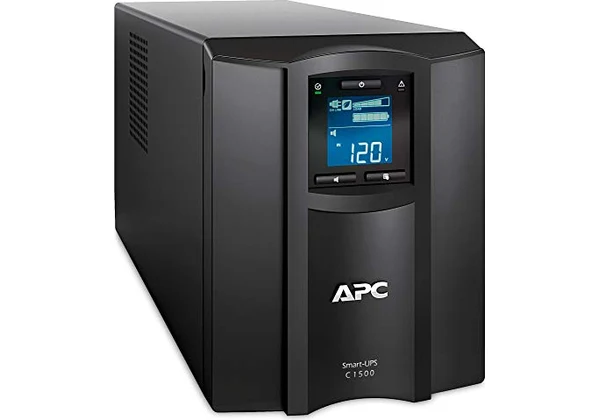 Photo: APC, Amazon
The APC Smart-UPS SMC1500IC delivers 1500 VA and 900 W with a pure sine wave and eight IEC C13 outlets. The SmartConnect port sends status to APC's cloud, so you can monitor the UPS from your phone. The 288 VAh battery recharges in 3 hours, and the replacement cartridge is the RBC6 (APC).
For a small office with a NAS and server, this is the premium choice. We found no runtime in minutes for this model (APC points to a runtime graph), so we don't give one. There are no Schuko outlets, so you need IEC cables.
| Feature | Detail |
|---|---|
| Power | 1500 VA / 900 W |
| Type | line-interactive, AVR |
| Waveform | pure sine wave |
| Outlets | 8x IEC C13 |
| Battery | 288 VAh, RBC6 cartridge |
| Monitoring | SmartConnect, LCD, USB |
| Price | 611.07 € |
Pros: remote cloud monitoring, fast recharge, replacement batteries readily available.
Cons: IEC outlets only, expensive.
Our opinion: Too expensive for a home. It makes sense in a small office, where you want your phone to tell you the power is out before a colleague calls.
Conclusion: which UPS device to choose?
UPS devices are chosen by what you plug in. For a router and ONT, the APC Back-UPS BX750MI-GR is enough. For a gas boiler, get a pure sine wave, and the cheapest is the Green Cell PowerProof 1000VA. For a gaming PC, pick the CyberPower CP1200EIPFCLCD, and for an unstable grid the online CyberPower OLS1000EA-DE.
| If you need... | Get | Price |
|---|---|---|
| UPS for router and ONT | APC Back-UPS BX750MI-GR | 89.17 € |
| UPS for a home office | Eaton 5E Gen2 5E1200UD | 185.10 € |
| UPS for a gas boiler, low budget | Green Cell PowerProof 1000VA | 139.00 € |
| Proven UPS for a boiler | PowerWalker VI 1000 CSW | 196.84 € |
| UPS for a gaming PC | CyberPower CP1200EIPFCLCD | 275.07 € |
| Online UPS | CyberPower OLS1000EA-DE | 277.74 € |
| Small office with monitoring | APC Smart-UPS SMC1500IC | 611.07 € |
If you need power for hours rather than minutes, look at generators. For data on NAS devices, a UPS with USB allows a clean shutdown.
Frequently asked questions
How long does a UPS keep a computer running?
Usually 5 to 15 minutes, enough to save your work and shut down. The CyberPower CP1200EIPFCLCD lasts 11.4 minutes at half load. A router on a small UPS can run for over an hour, because it draws only 10 to 20 W (estimate).
What is the difference between VA and W?
VA is apparent power and W is real power. The watt figure is lower: 750 VA on the APC BX750MI-GR means 410 W. Choose a UPS by watts, with 20 to 30 % headroom.
Line-interactive or online UPS?
For a home computer, router and boiler, a line-interactive pure sine wave unit is enough. An online UPS switches to battery in 0 ms and always outputs clean power, and is worth it with an unstable grid and sensitive equipment.
Does a gas boiler need a pure sine wave UPS?
Usually yes. APC says a simulated sine wave is not particularly compatible with most motor loads, and a circulation pump is a motor. Check the boiler's manual, and have an electrician connect a hard-wired boiler to the UPS.
When should I replace the UPS battery?
According to APC, a lead-acid battery lasts 3 to 5 years at 25 °C. If the UPS shuts off as soon as the power goes out or reports a battery fault, it's time for a replacement.
What size UPS do I need?
Add up the watts of your devices and add 20 to 30 %. A router needs only the smallest UPS (about 400 W). For a gas boiler with a pump, 600 to 700 W leaves enough headroom for the start-up current, and a gaming PC with a monitor 720 W or more.
How we chose
We chose the UPS devices in this comparison by wattage, waveform, type (line-interactive or online), outlets, runtime, price and availability on Amazon.de. We considered more than ten models and left out the APC Back-UPS Pro BR900G-GR (despite the "Pro" name it outputs a stepped sine wave) and the Eaton Ellipse PRO 1200 (we couldn't confirm its battery waveform). We checked every ASIN through the Amazon API. Specifications are from the manufacturers, and the advice on sine waves, batteries and printers comes from Schneider Electric's documentation. Prices are live Amazon.de prices as of 11 November 2026. We did not test the UPS devices ourselves.
Sources and references
- Schneider Electric - Back-UPS and motor loads
- Schneider Electric - UPS battery life
- APC - laser printers on a UPS
- Sikich - line-interactive and online UPS
- solaranlage-tipps.de - backup power for heating
- Allround-PC - CyberPower PFC Sinewave review
- APC - Back-UPS BX750MI-GR
- Eaton - 5E Gen2
- CyberPower - CP1200EIPFCLCD
- CyberPower - OLS1000EA-DE
- Digitec - PowerWalker VI 1000 CSW
- APC Back-UPS BX750MI - datasheet
Related articles: