
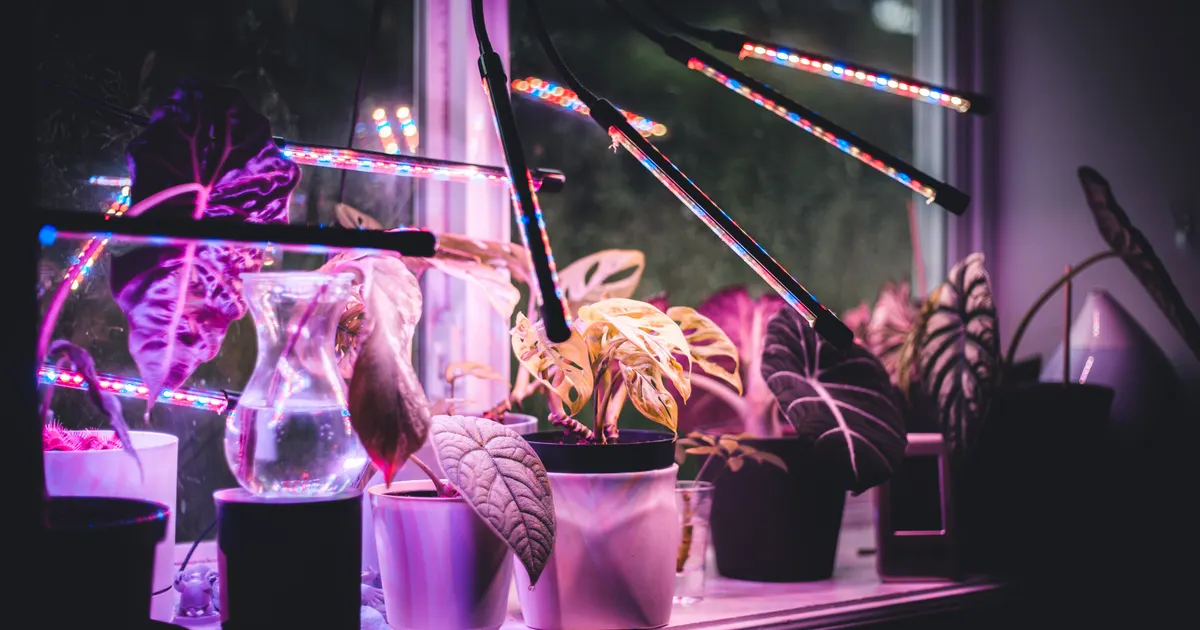

The LED grow lights in this comparison cost from 16.38 euros for a 15 W Sansi bulb to 94.99 euros for the Mars Hydro TS1000 on Amazon.de. This guide is for anyone growing tomato and pepper seedlings in winter, keeping houseplants in a dark flat or wanting basil in the kitchen, who isn't sure whether they need a board, a light bar or a bulb. The best LED grow lights of 2027 are the Spider Farmer SF1000 as an efficient 100 W board for a whole shelf of seedlings (79.99 euros), Barrina T5 as 2 x 10 W light bars for shelves (36.99 euros) and the Sansi clip-on light with two heads and a timer for houseplants (47.99 euros). We compared seven models with live prices as of 12 November 2026.
With LED grow lights, look at the actual power draw, not the "equivalent" in the title. The Sansi light is sold on Amazon as "300W" but actually draws 2 x 10 W.
Quick overview: best LED grow lights 2027
All LED grow lights in this comparison are available on Amazon.de. Click a name to see the current price.
| Model | Type | Actual power | Spectrum | Timer | Price | Best for |
|---|---|---|---|---|---|---|
| Spider Farmer SF1000 | board | 100 W | full + red | no | 79.99 € | Seedling shelves |
| Mars Hydro TS1000 | board | 150 W | full + red | no | 94.99 € | Growing to harvest |
| Barrina T5 2x10W | 59 cm bars | 20 W | white 5000K | no | 36.99 € | Shelves and cabinets |
| Sansi clip-on with timer | clip, 2 heads | 20 W | 4000K | 4/8/12 h | 47.99 € | Houseplants |
| Sansi 15W E27 | E27 bulb | 15 W | 4000K | no | 16.38 € | An existing lamp |
| Ledvance Indoor Garden Kit Pro | growing system | 24 W | 3600K | automatic | 76.48 € | Herbs |
| Osram LED Star Grow T80 | E27 bulb | 20 W | 3 modes | no | 17.31 € | A known brand |
Data comes from the manufacturers. There are hardly any independent tests of these models; the only one we found is Bob Vila's test of the Mars Hydro TS1000.
How to choose an LED grow light
PPFD and DLI: how much light plants need
Plants use light between 400 and 700 nm for photosynthesis (MSU), known as PAR. PPFD tells you how much of that light falls on a surface per second (µmol/m²/s), and DLI how much accumulates over a day (mol/m²/day) (Iowa State University).
Erik Runkle of Michigan State University gives indicative daily needs: seedlings 6 to 10 early on and 10 to 15 later, leafy greens and herbs 12 or more, and fruiting vegetables 15 or more mol/m²/day (MSU). You can work out the PPFD you need with the formula DLI x 277.8 / hours of light (MSU). For a DLI of 12 and 16 hours, that's about 208 µmol/m²/s.
How many hours a day
Give seedlings 16 hours of light, 18 at most, on an automatic timer (University of Illinois). For houseplants Iowa State recommends 12 to 14 hours. Connect LED grow lights without a timer to a smart plug or a cheap mechanical timer.
Distance from the plant
Iowa State says most LED lights can be 30 to 60 cm from the foliage. For winter seedlings, Nebraska Extension advises 7.5 to 15 cm above the leaves, raising the light as the plants grow (Nebraska Extension). Strong LED grow lights such as boards hang higher, weak bars and bulbs closer.
Why seedlings get leggy
Long thin stems and small leaves are a sign of too little light. The University of Vermont adds that the lights are probably too high (UVM). Lower them or extend the light duration.
White or purple light
Purple lights made of red and blue diodes are the most efficient at turning electricity into light, but plants under them don't look green, which makes problems harder to spot. White LEDs are easier on the eyes, similarly useful to plants and usually only slightly less efficient (MSU). For a living room, choose white LED grow lights.
How much electricity they use
Calculate consumption like this: power in watts x hours a day x number of days / 1000 = kWh. The 100 W Spider Farmer SF1000 at 16 hours a day uses about 48 kWh a month, the 20 W Barrina about 9.6 kWh, and the 15 W Sansi at 12 hours about 5.4 kWh. Multiply by the price per kWh on your electricity bill.
When to sow seedlings
Tomatoes and peppers are among the first to be sown. On a windowsill they can go in as early as February, and raising seedlings takes 40 to 70 days (Novi list). Zagreb's gardening handbook gives sowing for tomatoes and peppers from February to April and transplanting in May (City of Zagreb). That's when LED grow lights are most useful, because the days are still short.
1. Spider Farmer SF1000
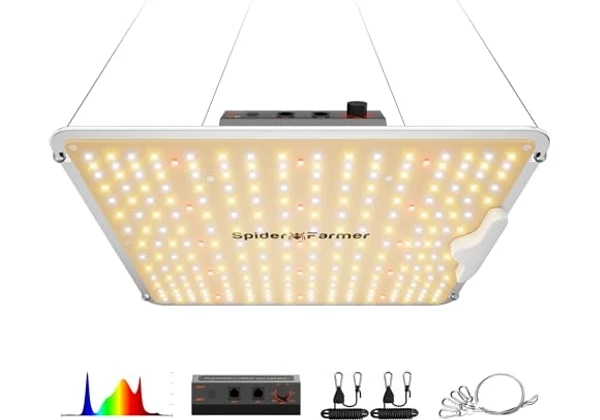 Photo: Spider Farmer, Amazon
The Spider Farmer SF1000 is a 100 W LED quantum board with a PPF of 249 µmol/s and an efficiency of 2.5 µmol/J. The spectrum is full white with added red and infrared, and it covers 90 x 90 cm for vegetative growth and 60 x 60 cm for flowering. It has a dimmer knob, no fan and a 5-year warranty (Spider Farmer).
Of the LED grow lights that publish µmol/J, this is the most efficient in the comparison, and it covers a whole shelf of seedlings. It looks industrial, needs to be hung above the plants and has no built-in timer.
| Feature | Detail |
|---|---|
| Type | quantum board |
| Power | 100 W |
| PPF | 249 µmol/s |
| Efficiency | 2.5 µmol/J |
| Coverage | 90 x 90 cm (veg) |
| Dimmer | yes |
| Price | 79.99 € |
Pros: high efficiency, dimmable, silent without a fan, 5-year warranty.
Cons: industrial look, no timer, needs to be hung.
Our opinion: If you're growing seedlings for a whole garden, this is the LED grow light we'd buy. Low power for sprouts, full power once the plants grow.
2. Mars Hydro TS1000
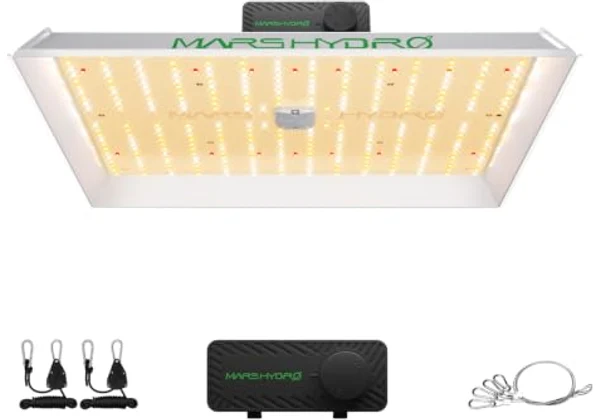 Photo: Mars Hydro, Amazon
The Mars Hydro TS1000 is a 150 W board with a PPF of 343 µmol/s and an efficiency of 2.3 µmol/J. It dims from 0 to 100 % on the external driver, and Mars Hydro gives coverage of 60 x 60 to 75 x 75 cm (Mars Hydro). App control is only possible with extra equipment sold separately.
Bob Vila tested it and rated it 9.2/10, noting that cacti and succulents in a dark basement grew almost as well as a control group in a greenhouse (Bob Vila). It's the most powerful in the comparison, but it has no IP65 rating.
| Feature | Detail |
|---|---|
| Type | board with reflector |
| Power | 150 W |
| PPF | 343 µmol/s |
| Efficiency | 2.3 µmol/J |
| Coverage | 60 x 60 to 75 x 75 cm |
| Dimmer | 0-100 % |
| Price | 94.99 € |
Pros: most powerful in the comparison, tested, silent.
Cons: no IP65 rating, industrial look, app only with extra equipment.
Our opinion: The TS1000 is for those who want to grow tomatoes and peppers to harvest indoors. For seedlings, the SF1000 is enough and cheaper.
3. Barrina T5 2x10W
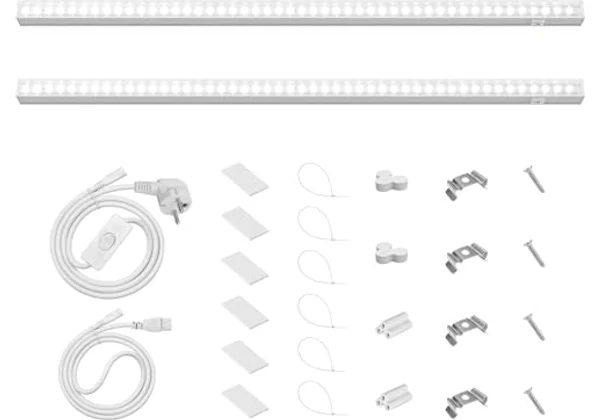 Photo: Barrina, Amazon
The Barrina T5 kit has two 59 cm bars of 10 W each, with a white 5000K spectrum. Each bar has a switch, up to 16 bars can be linked, and the package includes tape, clips and ties for mounting under a shelf (Barrina).
They're slim and fit under a shelf or in a cabinet. The manufacturer doesn't publish PPFD, and at 10 W per bar they need to be close to the plants.
| Feature | Detail |
|---|---|
| Type | T5 bars, 59 cm |
| Power | 2 x 10 W |
| Spectrum | white 5000K |
| Beam angle | 120° |
| Linking | up to 16 bars |
| Timer | no |
| Price | 36.99 € |
Pros: ideal for shelves, pleasant white light, modular, low consumption.
Cons: little light per bar, no timer or dimming, PPFD not published.
Our opinion: Barrina is the most practical solution for seedlings on a shelf. Hang them a few centimetres above the pots and connect them to a timer.
4. Sansi clip-on with timer (2x10W)
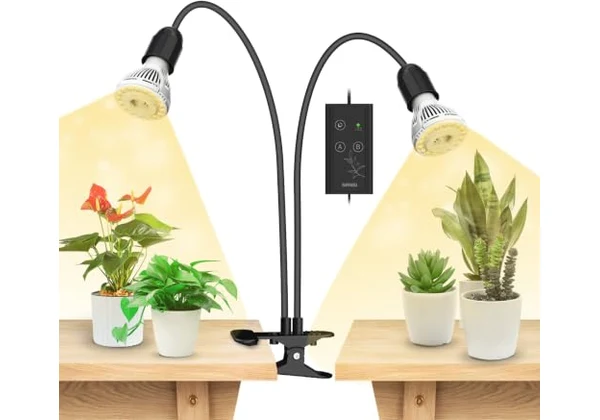 Photo: Sansi, Amazon
The Sansi light has a clip and two flexible heads with replaceable 10 W E27 bulbs. Maximum PPFD is about 196 µmol/m²/s at 30 cm, the spectrum is 4000K, and the built-in timer runs for 4, 8 or 12 hours and repeats daily (Amazon). The listing title says "300W", which is an equivalent, not the actual draw.
On a desk or windowsill it takes up little space, and you can point the heads where needed. The timer only goes up to 12 hours, so for 16-hour seedlings you need an external timer.
| Feature | Detail |
|---|---|
| Type | clip, 2 heads |
| Power | 2 x 10 W |
| PPFD | up to about 196 µmol/m²/s at 30 cm |
| Spectrum | 4000K |
| Timer | 4/8/12 h |
| Bulbs | E27, replaceable |
| Price | 47.99 € |
Pros: built-in timer, replaceable bulbs, two heads for several pots.
Cons: timer only up to 12 h, needs a sturdy edge, no dimming.
Our opinion: For houseplants, this is the LED grow light we'd buy. Switch it on, set the timer to 12 hours and forget about it.
5. Sansi 15W E27
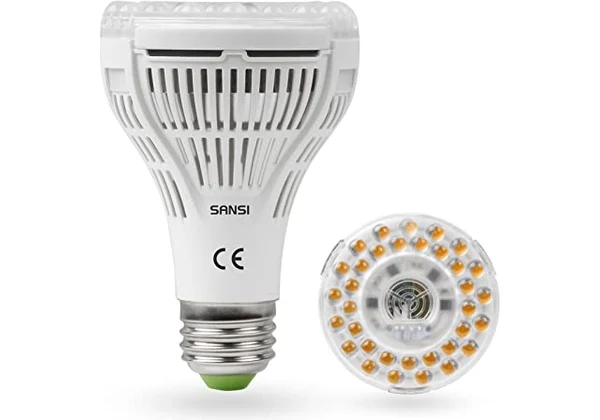 Photo: Sansi, Amazon
The Sansi 15W is an LED bulb with an E27 base and a lens that focuses the light on the plant. It draws 15 W, gives a PPF of 27 µmol/s and a PPFD of 153 µmol/m²/s at 30 cm, with a 4000K spectrum (Amazon).
It fits an existing desk or floor lamp, and the white light doesn't look like grow lighting. It only covers one or two plants and is larger than a normal bulb.
| Feature | Detail |
|---|---|
| Type | E27 bulb with lens |
| Power | 15 W |
| PPF | 27 µmol/s |
| PPFD | 153 µmol/m²/s at 30 cm |
| Spectrum | 4000K |
| Beam angle | 60° |
| Price | 16.38 € |
Pros: cheapest way to start, fits an existing lamp, white light.
Cons: small coverage, no dimmer, no timer.
Our opinion: For a single monstera or fig in a dark corner, this bulb in an existing lamp is enough.
6. Ledvance Indoor Garden Kit Pro
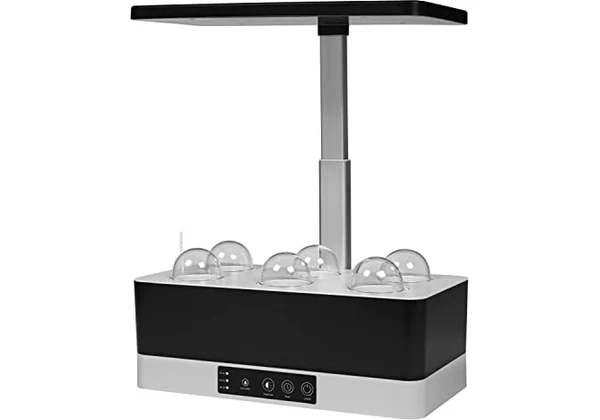 Photo: Ledvance, Amazon
The Ledvance Indoor Garden Kit Pro is a countertop growing system with six spots, a 24 W, 1670 lm LED light at 3600K and a height-adjustable head. It has an automatic day-night cycle and a sensor that warns when water runs low (Ledvance).
It looks like a kitchen appliance and runs itself. It only has six spots, so it isn't for seedlings in larger numbers.
| Feature | Detail |
|---|---|
| Type | growing system |
| Power | 24 W |
| Light | 1670 lm, 3600K |
| Spots | 6 |
| Timer | automatic cycle |
| Water sensor | yes |
| Price | 76.48 € |
Pros: all-in-one, looks like a household appliance, known brand.
Cons: only six plants, expensive per watt, too small for trays of seedlings.
Our opinion: For fresh basil and parsley in the kitchen over winter, it's the simplest solution.
7. Osram LED Star Grow T80 20W
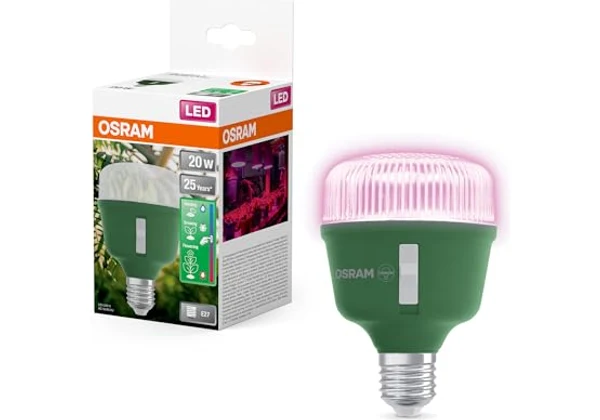 Photo: Osram, Amazon
The Osram LED Star Grow T80 is a 20 W, 650 lm E27 bulb with a 110° beam angle. A built-in switch selects one of three spectra, for sowing, growth and flowering, and it isn't dimmable (Ledvance).
Osram is a well-known name, and the bulb costs under 18 euros. Ledvance doesn't publish PPF, so it's hard to compare with the others, and an efficiency of 32 lm/W is low.
| Feature | Detail |
|---|---|
| Type | E27 bulb |
| Power | 20 W |
| Light | 650 lm |
| Spectrum | 3 modes on a switch |
| Beam angle | 110° |
| Dimmable | no |
| Price | 17.31 € |
Pros: known brand, cheap, three spectra in one bulb.
Cons: PPF not published, low efficiency, not dimmable.
Our opinion: The Osram makes sense if a known brand matters to you. For the same purpose, Sansi publishes PPFD.
Conclusion: which LED grow light to choose?
LED grow lights are chosen by what you grow. For a whole shelf of seedlings the Spider Farmer SF1000 is best, and for growing to harvest the Mars Hydro TS1000. For shelves and cabinets take the Barrina T5 bars, for houseplants the Sansi clip-on light with timer, and for herbs in the kitchen the Ledvance Indoor Garden.
| If you need... | Get | Price |
|---|---|---|
| Light for a seedling shelf | Spider Farmer SF1000 | 79.99 € |
| Growing vegetables to harvest | Mars Hydro TS1000 | 94.99 € |
| Bars for shelves | Barrina T5 2x10W | 36.99 € |
| A houseplant light with timer | Sansi clip-on with timer | 47.99 € |
| A bulb for an existing lamp | Sansi 15W E27 | 16.38 € |
| Herbs in the kitchen | Ledvance Indoor Garden Kit Pro | 76.48 € |
| A known brand in E27 | Osram LED Star Grow T80 | 17.31 € |
Once your seedlings grow, see greenhouses and raised garden beds for spring in the garden.
Frequently asked questions
Full spectrum or red-blue light?
At home, full spectrum, meaning white light. According to MSU it's similarly useful to plants as purple light, easier on the eyes and makes leaf problems easier to spot. Purple lights are slightly more efficient but unpleasant to be in a room with.
What are PPFD and DLI?
PPFD is the amount of photosynthetically useful light falling on a surface per second, in µmol/m²/s. DLI is the total daily amount, in mol/m²/day. Seedlings need roughly 6 to 15, and fruiting vegetables 15 or more mol/m²/day.
How far should the light be from the plant?
Most LED lights 30 to 60 cm from the foliage, according to Iowa State. Weaker bars and bulbs for seedlings can be 7.5 to 15 cm above the leaves. If seedlings get leggy, lower the light.
How many hours a day should it be on?
Seedlings 16 hours, 18 at most. Houseplants 12 to 14 hours. A timer or smart plug is the easiest way.
Can ordinary LED bulbs work?
Partly. University of Maryland Extension recommends lighting over 3,000 lumens at 5,000 to 6,500 K (daylight) for seedlings, and says there is no need to buy special blue or red lights (University of Maryland). A regular household bulb usually falls short of that, so a light with published PPFD is the safer choice.
How much electricity do they use?
Consumption is power x hours x days / 1000 in kWh. A 100 W board at 16 hours a day uses about 48 kWh a month, and a 15 W bulb at 12 hours about 5.4 kWh.
Why do seedlings get leggy?
Too little light. Long thin stems and small leaves show the light is too weak or too high. Lower it, turn it up or extend the light duration.
How we chose
We chose the LED grow lights in this comparison by actual power, published PPF or PPFD, efficiency, spectrum, timer, purpose, price and availability on Amazon.de. We considered ten models and left out the Mars Hydro TS600, Spider Farmer SF600 and ViparSpectra P1000, and we couldn't find Venlite or Roleadro on Amazon.de. We checked every ASIN through the Amazon API. Specifications are from the manufacturers, and the advice on light and growing from university extension services (Iowa State, Michigan State, Illinois, Vermont, Nebraska, Maryland) and Croatian sources. Prices are live Amazon.de prices as of 12 November 2026. We did not test the lights ourselves.
Sources and references
- Iowa State University - supplemental light for indoor plants
- Iowa State University - sources of light
- MSU - DLI requirements
- MSU - purple, pink and white LEDs
- University of Illinois - lighting for seed starting
- University of Vermont - choosing grow lights
- Nebraska Extension - LEDs for houseplants and transplants
- Novi list - raising seedlings
- City of Zagreb - gardening handbook
- Spider Farmer - SF1000
- Mars Hydro - TS1000
- Bob Vila - Mars Hydro TS1000 review
- Barrina - T5 10W
- University of Maryland - light choices for starting plants
- MSU - lighting plants indoors
- MSU - daily light integral defined
Related articles: